

How the Iran Nuclear Pretext Reveals a Broader Agenda of Coercion
In the annals of modern geopolitical theater, few phrases carry as much ironic baggage as “mission accomplished.” Eight months after the United States launched airstrikes on Iranian nuclear facilities under the codename “Operation Midnight Hammer,” President Donald Trump finds himself in a rhetorical loop: simultaneously claiming to have “obliterated” Iran’s nuclear program while threatening new military action to destroy that same program. This cognitive dissonance is not merely a gaffe—it is a revealing symptom of a deeper pattern. The nuclear file, long wielded as the primary justification for pressure on Tehran, is increasingly exposed as a flexible pretext for objectives that extend far beyond non-proliferation: regime change, regional containment, and the coercion of a sovereign state into compliance with Western strategic demands.
The Moving Goalpost: “Weeks Away” Since the 1990s
The claim that Iran is imminently on the verge of acquiring nuclear weapons is not new; it is a decades-old refrain. As far back as 1992, U.S. congressional reports asserted with “98 percent certainty” that Iran already possessed components for operational nuclear weapons. In 1995, then-Israeli parliamentarian Benjamin Netanyahu warned colleagues that Iran was “3 to 5 years” from a bomb—a timeline that would be repeated, with minor variations, for the next thirty years. By 2012, Netanyahu famously brandished a cartoon bomb at the United Nations, drawing a “red line” he claimed Iran would cross “by next summer.”
The 2015 Joint Comprehensive Plan of Action (JCPOA) was negotiated precisely because intelligence assessments, including those from the U.S. and the IAEA, indicated that diplomatic constraints could verifiably extend Iran’s “breakout time” to a nuclear weapon to over a year. Yet the agreement was abandoned in 2018, and the “imminent threat” narrative was promptly revived. After more than three decades of similar warnings, many observers say these nuclear alarm bells may serve broader political and military goals. The pattern is clear: the nuclear deadline is perpetually adjustable, serving not as an objective assessment but as a policy lever.
Beyond the Nuclear File: Missiles, Allies, and Regime Behavior
Today, the demands placed on Iran explicitly extend far beyond uranium enrichment. U.S. officials now openly state that any agreement must address Iran’s ballistic missile program and its regional partnerships. Iranian officials have consistently rejected these demands as non-negotiable intrusions into sovereign defense and foreign policy. “We only negotiate about our nuclear program with the United States,” stated Foreign Minister Seyed Abbas Araghchi, while Ali Shamkhani, advisor to Supreme Leader Khamenei, called the missile program a “red line.”
This expansion of demands confirms what critics have long suspected: the nuclear issue is a gateway. If Washington’s objective were genuinely limited to preventing a nuclear weapon, the successful constraints of the JCPOA—and the IAEA’s repeated verification that Iran was complying prior to 2018—would have sufficed. Instead, the goalposts shift to encompass the very pillars of Iran’s strategic autonomy. As one regional analyst put it: “The target from the very beginning was not just Iran’s nuclear program; it was Iran as a state and the regime itself. The nuclear file is merely a pretext.”
The Selective Application of Non-Proliferation
The hypocrisy of the Western non-proliferation stance is stark when viewed globally. Cuba, which possesses no nuclear weapons program, has endured a comprehensive U.S. economic embargo for over six decades, justified initially by Cold War ideology and maintained through successive administrations. Meanwhile, states that openly possess nuclear weapons outside the Nuclear Non-Proliferation Treaty (NPT)—Israel, India, and Pakistan—face no comparable sanctions regime. Israel, widely estimated to possess 80-90 nuclear warheads, maintains a policy of “ambiguity” and has never been subjected to U.S. punitive measures for its arsenal. India and Pakistan conducted nuclear tests in 1998 and were initially sanctioned, but those penalties were swiftly lifted as strategic partnerships deepened. North Korea, while heavily sanctioned, has engaged in direct diplomatic summits with U.S. presidents—a level of engagement denied to Iran despite its adherence to the JCPOA. This double standard undermines the moral authority of non-proliferation demands. Nowhere are double standards and hypocrisy more evident than in relation to Israel and its nuclear policy. When non-proliferation is applied selectively, it ceases to be a principle and becomes a tool of geopolitical coercion.
Unauthorized Strikes and the Erosion of International Law
The June 2025 U.S. strikes on Iranian nuclear facilities at Fordow, Natanz, and Isfahan were conducted without authorization from the United Nations Security Council. Multiple UN documents and expert statements condemned the attacks as violations of international law, noting that the targeted facilities were under IAEA safeguards and dedicated to peaceful purposes. Yet the U.S. administration framed the strikes as a non-negotiable act of self-defense, setting a dangerous precedent: that a single state may unilaterally decide to bomb another’s safeguarded civilian infrastructure based on contested intelligence.
This action further exposes the nuclear pretext. If the program had truly been “obliterated,” as Trump and his cabinet claimed, why the continued threats and demands? The contradiction suggests that the military action served not to eliminate a technical capability, but to signal resolve, weaken the Iranian state, and create leverage for broader negotiations. As one analysis aptly asks: “If he and his team claimed a mission was accomplished eight months ago… why would you believe anything they say about anything at all?”
The Venezuela Parallel: Regime Change by Any Name
The playbook is familiar. In Venezuela, the United States imposed crippling sanctions and recognized an opposition figure as interim president, explicitly seeking regime change under the banner of promoting democracy and human rights. No nuclear program was involved. The objective was political alignment. Analysts have drawn direct parallels to Iran, noting that the realities of operability, which allowed an invasion to occur in Venezuela, highlight why a similar intervention in Iran is simply out of the question due to Iran’s greater military capacity. Yet the underlying strategy—using economic warfare, diplomatic isolation, and the threat of force to compel political change—remains consistent.When the same administration that bombed Iran’s nuclear sites also pushes for “regime change” rallies outside Mar-a-Lago, the connection becomes explicit. The nuclear issue provides a legally and morally palatable entry point for actions whose ultimate aims are geopolitical realignment.
The Expanding Circle of Threats: When Former Partners Become Targets
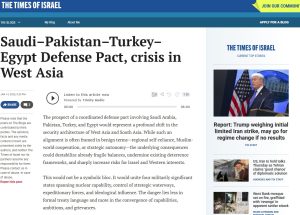 Perhaps the most consequential development in this unfolding drama is the rhetorical expansion of who qualifies as a “threat.” In a February 2026 cabinet meeting, Israeli Prime Minister Benjamin Netanyahu spoke openly of forming a regional “alliance” to counter what he described as both a “hardline Shia axis” and an “emerging hardline Sunni axis”, consiting of Saudi Arabia, Turkey, Egypt, and Paksitan. According to reports, Netanyahu proposed a network of partnerships including India, Arab and African countries, Greece, Cyprus, and other Asian states—united not by shared values or mutual development goals, but by opposition to neighbors he labeled “radical.”
The implications for regional diplomacy are profound. For years, Western and Israeli strategy in the Middle East relied on a simple binary: states aligned with Tehran were adversaries; those opposed to Iran were potential partners. Saudi Arabia, Turkey, Egypt, and the Gulf monarchies were cultivated as counterweights to Iranian influence, often with tacit or explicit security guarantees. But when the definition of “radical” expands to include Sunni-majority states that simply pursue independent foreign policies—or decline to join an Israeli-led coalition—the foundation of that strategy crumbles.
If Tehran can be targeted for its missile program and regional partnerships today, what prevents Riyadh or Ankara from becoming tomorrow’s “emerging threat”? The logic of preemption, once applied selectively, becomes contagious. Regional capitals are taking note. The silence from Arab governments following Netanyahu’s remarks is not acquiescence; it is strategic caution. Behind closed doors, foreign ministries are reassessing the risks of alignment with powers that reserve the right to redefine allies as adversaries based on shifting political winds.
This dynamic is likely to accelerate a trend already visible across the Global South: the pursuit of strategic autonomy through diversified partnerships. Countries that once looked primarily to Washington or European capitals for security guarantees are now deepening ties with Beijing, Moscow, New Delhi, and regional blocs. They are investing in indigenous defense capabilities, alternative financial systems, and diplomatic frameworks that do not hinge on Western approval. The lesson of Iran—that compliance with one set of demands only invites new ones—is being internalized far beyond Tehran.
The nuclear pretext, once a potent tool for coercion, is losing its persuasive power. When the same actors who claim to uphold non-proliferation norms simultaneously bomb safeguarded facilities without international authorization, and then redefine regional diplomacy through sectarian lenses, credibility erodes. Former partners begin to ask: if the goalposts can move for Iran, why not for us?
Seeing the Pretext Clearly
The evidence is now overwhelming. The perpetual “weeks away” narrative, the expansion of demands to missiles and regional policy, the selective enforcement of non-proliferation norms, the unilateral military strikes without UNSC mandate, and the explicit linkage to regime change objectives all point to a single conclusion: the Iranian nuclear program has been instrumentalized as a pretext.
This is not to argue that nuclear proliferation is unimportant. It is to insist that when non-proliferation is wielded inconsistently and opportunistically, it loses its legitimacy and becomes a mask for power politics. As the international community watches the latest iteration of the “mission accomplished” drama unfold, the lesson should be clear: sustainable security cannot be built on moving goalposts and double standards. It requires principled, consistent diplomacy that addresses the legitimate security concerns of all states—not just the most powerful. Until then, the cycle of crisis, coercion, and conflict will continue, with the nuclear pretext serving as its most convenient and durable fuel.
And as the circle of perceived threats expands to include former partners, the world may finally witness the limits of coercion as a strategy. When every sovereign choice can be framed as a threat, the only rational response for nations is to seek security not through alignment with hegemonic powers, but through resilience, diversification, and solidarity with others who refuse to accept a world order defined by perpetual exception and selective enforcement.
Sources Cited
Brennan, C. (2026). Trump can’t remember whether he ‘obliterated’ Iran’s nukes. USA TODAY.
Peterson, S. (2011). Imminent Iran nuclear threat? A timeline of warnings since 1979. Christian Science Monitor.
Decades of Deadlines: Netanyahu’s Long History of Claiming Iran Is “Just About” to Get a Nuclear Bomb. Quds News.
Xinhua. (2026). Iran says distrust of West stalls nuclear talks, describing missile program as “red line”.
Congressional Research Service / National Security Archive. U.S. Economic Sanctions on Cuba.
House of Commons Library / Bulletin of the Atomic Scientists. Israel’s nuclear weapons and U.S. policy.
Arms Control Association / UK Parliament. Nuclear weapons profiles: India and Pakistan.
United Nations Security Council Documents & OHCHR. Condemnation of U.S. strikes on Iranian nuclear facilities.
Al Jazeera. (2026). Why Trump’s regime-change playbook won’t work in Iran.
Middle East Monitor. (2026). Netanyahu speaks of forming ‘alliance’ against ‘Sunni and Shia axes’ including Arab states.