
How Primary Politics Institutionalizes Prejudice Against American Muslims
American democracy faces a profound paradox: the very mechanisms designed to ensure representative governance—the primary election system—have become accelerants of corrosive rhetoric that inflicts lasting damage upon the nation’s social fabric. In the pursuit of narrow electoral victories, political actors increasingly deploy narratives rooted in fear, misinformation, and dehumanization. While such strategies may yield short-term advantages in partisan primaries, they exact a far greater long-term cost by normalizing bigotry, embedding discrimination within institutional frameworks, and legitimizing violence against vulnerable communities. The recent escalation of anti-Muslim rhetoric in Texas Republican primaries exemplifies this dangerous dynamic, revealing how politically expedient fearmongering transforms transient campaign tactics into enduring instruments of societal harm.
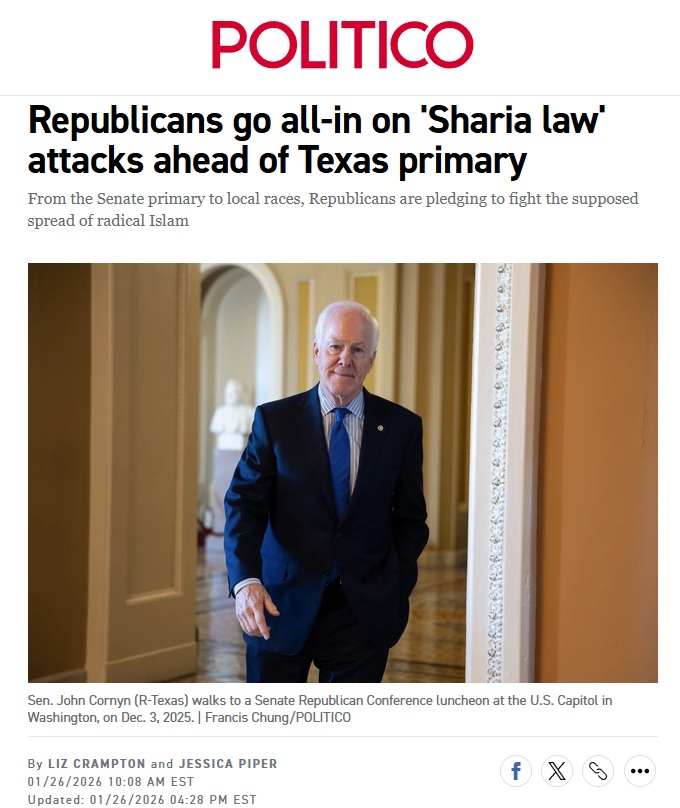
The current political landscape in Texas demonstrates the mechanics of this corrosive process with alarming clarity. As documented in recent reporting, Republican candidates across multiple races—from the U.S. Senate contest between Senator John Cornyn and Attorney General Ken Paxton to local attorney general and congressional races—have made opposition to “Sharia law” and Muslim community development central pillars of their campaigns. Candidates have deployed inflammatory advertisements depicting Islam as inherently violent, questioned the compatibility of Islamic faith with Western civilization, and in one extreme instance, featured footage of Quran burning accompanied by graphic threats of sexual violence and beheadings. Such rhetoric does not emerge spontaneously; it is calibrated, tested, and deployed because, as one Republican consultant candidly admitted, “this message works” with primary voters. The political marketplace of primaries thus creates perverse incentives: candidates compete not on policy substance or governing competence, but on who can most effectively stoke fear of a religious minority comprising less than one percent of Texas’s population.
This transactional deployment of bigotry carries consequences far beyond election day. When candidates institutionalize prejudice through legislation and executive action, campaign rhetoric metastasizes into structural discrimination. Texas Governor Greg Abbott has signed laws banning so-called “Sharia compounds” and designating mainstream Muslim advocacy organizations as terrorist entities—measures enacted amid the very primary campaigns that amplified anti-Muslim sentiment. Attorney General Paxton has launched multiple investigations and lawsuits against a planned Muslim residential development near Dallas, framing routine religious community planning as a “radical plot.” Senator Cornyn has introduced federal legislation to revoke the tax-exempt status of the Council on American-Islamic Relations. These actions transform ephemeral campaign talking points into codified policy, embedding religious discrimination within the machinery of state government. The Justice Department’s quiet closure of its investigation into the Plano development without charges underscores how political theater masquerading as governance wastes public resources while inflicting reputational and financial harm on law-abiding citizens exercising their constitutional rights.
The toxicity of this approach extends beyond legal frameworks to the psychological safety of American Muslims. When elected officials and candidates characterize an entire faith tradition as “bloodthirsty” or incompatible with American values, they provide implicit sanction for private acts of discrimination and violence. Research consistently demonstrates that political rhetoric normalizing prejudice correlates with increased hate incidents against targeted groups. The escalation from questioning mosque construction to depicting graphic violence against non-combatants represents not merely rhetorical excess but a dangerous continuum that erodes the social contract protecting religious minorities. American Muslims—who include veterans, first responders, educators, and business owners contributing to their communities—find themselves perpetually defending their patriotism and humanity against manufactured controversies designed solely to energize a political base.
Most shortsighted of all is the strategic miscalculation underlying this approach. Politicians deploying anti-Muslim rhetoric operate within an increasingly diverse America where demographic realities contradict their fear-based narratives. Texas itself—with non-Hispanic whites comprising less than 40 percent of its population—exemplifies the nation’s multicultural trajectory. By institutionalizing discrimination against one minority group today, political actors establish precedents that can be weaponized against others tomorrow. The same legal mechanisms used to target Muslim communities could readily be redirected against Jewish, Sikh, Hindu, or other religious minorities when political expediency demands. Furthermore, the alienation of Muslim Americans—who participate actively in civic life and vote at significant rates—represents not merely a moral failure but a strategic blunder that cedes electoral ground while poisoning the well of democratic discourse for future generations.
The corrosion of American politics through expedient bigotry ultimately damages the nation’s global standing and self-conception. When the world’s oldest continuous democracy enacts laws singling out a religious minority for special scrutiny based on theological misconceptions about “Sharia law”—a term encompassing diverse interpretations of Islamic jurisprudence, not a monolithic legal code imposed on non-Muslims—it undermines its moral authority to advocate for religious freedom abroad. It betrays foundational American principles enshrined in the First Amendment’s dual protections of free exercise and against establishment of religion. Most tragically, it teaches young Americans that political success requires the denigration of neighbors, that patriotism necessitates suspicion of the religiously different, and that democratic participation rewards the amplification of fear over the cultivation of understanding.
The path forward requires recognizing that primary elections must not become laboratories for normalizing hatred. Political parties bear responsibility for establishing norms that reject dehumanizing rhetoric. Media institutions must contextualize inflammatory claims rather than amplifying them as spectacle. Voters must demand accountability from candidates who trade in bigotry for votes. And civil society must remain vigilant in defending constitutional principles when political expediency threatens to erode them.
The choice before American democracy is not merely between competing political visions but between transient electoral advantage and enduring national character. When politicians institutionalize prejudice to win primaries, they may secure nominations—but they sacrifice something far more valuable: the possibility of a pluralistic society where religious identity never determines one’s standing as an American. The damage inflicted today will not vanish with the next election cycle; it will linger in statutes, in social attitudes, and in the hearts of citizens taught that their faith makes them suspect. In the calculus of democratic health, no primary victory justifies such permanent corrosion of the body politic.
Source: Bresnahan, J. (2026, January 26). Republicans go all-in on ‘Sharia law’ attacks ahead of Texas primary. Politico. https://www.politico.com/news/2026/01/26/republicans-go-all-in-on-sharia-law-attacks-ahead-of-texas-primary-00745647