
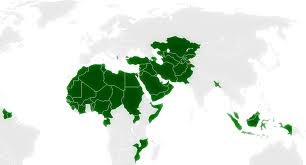
For six days, representatives of member states of the United Nations talked about their most pressing issues. One after one, they addressed mostly an empty hall updating the General Assembly about their achievements and reminding the world about the problems that must be solved. Leaders of the Islamic world were present, although not all key players attended the yearly event.
The kings of Saudi Arabia and Morocco for instance did not attend. Turkey, too, elected to send the foreign minister instead of the prime minister or the president. Syria’s embattled president, too, was understandably unable to attend. But leaders who made it, expressed a wide range of concerns, and most importantly, the new realities emerging as a result of the Arab Spring. However, representatives of two Islamic countries received more attention than the rest: Iran’s president and Egypt’s.
President Mahmoud Ahmadinejad, who is serving his last year in office, brought with him a huge entourage. He delivered the usual speech he has been delivering for the past seven years and offered numerous interviews where he faced the same questions about the nuclear program and real and imagined human rights abuses. He offered his radical insight about solving the Palestinian-Israeli conflict and sidestepped questions about the two-state solution.
Mohammed Morsi, Egypt’s new president, delivered a speech highlighting the role his country could play in stabilizing the region. He, too, emphasized the need to solve the Palestinian-Israeli conflict but was short on specifics. He brought to the attention of the General Assembly his attempt to end the Syrian crisis based on his vision that requires Assad to step down without foreign intervention.
What was notable about these leaders (as is the case with most Arab leaders), is that fact that it was impossible to distinguish personal opinions from state policies. In the case of the Iranian president, given that he was serving his last term in office, it would have been helpful if the interviewers asked him to distinguish between his personal opinion from the formal policy as established by the various institutions especially that of the supreme leadership.
In the case of Morsi, given that there are currently no other legitimate governing institutions, he is acting and speaking as if he has the final say on all matters. In the absence of an elected parliament and a ratified constitution, he is likely to continue the one-man rule and that must remind the Egyptian people of an era they want to forget.
The other dramatic but not surprising event at the General Assembly debate was Israel’s prime minister’s cartoonish cartoon explaining the threat of a nuclear armed Iran. His emphasis on outside threats and his lack of interest in solving the conflict with the Palestinians destroyed his credibility. After all, even the Iranian president conceded that if the Palestinians were to reach a just settlement with the Israelis, then he will have to respect their decision, which would render the Iranian threat a moot point.
In the end, the numerous speeches and long list of demands only highlighted the impotence of the General Assembly. The UNSC remains the organ of this organization most equipped to deal critical issues. But it, too, suffers from structural deficiencies.
ISR45610041289
