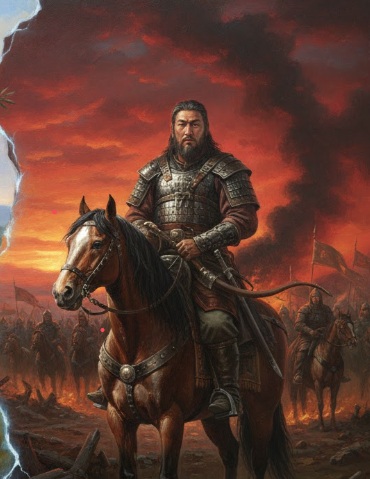
Israeli Prime Minister Benjamin Netanyahu recently offered the world a stark proposition: “Jesus Christ has no advantage over Genghis Khan.” Quoting historian Will Durant, he argued that in a dangerous world, morality without power is futile—that to defeat evil, one must be willing to match its ruthlessness. It is a compelling soundbite for an age of anxiety. But it is also a false choice, one that crumbles under scrutiny, contradicts Netanyahu’s own rhetoric, and misunderstands the long arc of history.
The truth is more nuanced, and more hopeful: cruelty may win battles, but it does not win history. And no serious leader—not even Netanyahu—actually believes otherwise.
Netanyahu’s philosophy contains a fundamental contradiction. While arguing that morality is a luxury the righteous cannot afford, he consistently frames Israel’s military actions in explicitly moral terms. He describes the Israel Defense Forces as “the most moral army in the world.” He insists that Israel fights “against evil.” He defends controversial operations as necessary acts of self-defense against barbarism.
If morality truly conferred “no advantage,” why cling to this language? Why not simply admit: We do what we must, because we can? The answer is revealing. Even those who advocate ruthlessness understand that legitimacy—domestic and international—depends on moral narrative. Power alone is unstable; it requires justification. Every war, every conquest, every act of state violence has been accompanied by a story of righteousness. The Assyrians, the Romans, the Mongols, the colonial empires: all claimed divine favor, civilizing missions, or existential necessity. The narrative may mask deeper drives—territory, resources, dominance—but it is never discarded. Winners do not celebrate their cruelty; they sanitize it.
Netanyahu is no exception. His appeal to Christian conservatives in the United States, his invocation of shared Judeo-Christian values, his insistence that Israel upholds democratic principles—all of these depend on a moral framework he claims is irrelevant to survival. The incoherence is not accidental. It reflects a deeper ideology: not that morality is useless, but that my side’s morality is the only one that counts. This is not realism. It is supremacism dressed in the language of necessity.
It is true that brute force can determine short-term outcomes. Genghis Khan’s armies swept across continents; empires have risen on the backs of enslaved peoples; aggressors have seized territory and held it for generations. But look at how these victories are remembered.
No modern state celebrates its founding as an act of pure conquest. The United States does not teach that it won the West through genocide alone; it tells a story of liberty, destiny, and democratic expansion. Britain does not memorialize empire as raw exploitation; it emphasizes law, infrastructure, and “the white man’s burden.” Even the Mongol Empire, for all its terror, is now often framed in terms of trade routes, cultural exchange, and administrative innovation.
Why? Because lasting power requires more than fear. It requires consent, identity, and a story people are willing to pass to their children. Cruelty may subdue; it does not inspire loyalty. It may win a war; it does not build a civilization.
Netanyahu’s comparison of Jesus and Genghis Khan invites a simple empirical test: by what measure do we judge “advantage”?
If the metric is immediate territorial conquest, Genghis Khan wins. His empire stretched from the Pacific to Eastern Europe. But if the metric is enduring influence—shaping values, inspiring movements, commanding the allegiance of billions across millennia—the verdict reverses dramatically.
Jesus of Nazareth, who preached love of enemy, turned the other cheek, and died by state execution, now has over 2.4 billion followers. His teachings underpin legal systems, human rights frameworks, and moral philosophies across the globe.
Genghis Khan, for all his military genius, has no major world religion, no global ethical system, no mass movement that identifies him as a moral exemplar. His legacy is studied, sometimes admired for its scale, but rarely emulated as a guide for life.
The Prophet Muhammad, who engaged in warfare but within ethical constraints emphasized in Islamic tradition—prohibitions against killing non-combatants, destroying crops, or torturing prisoners—today guides the faith and practice of nearly 2 billion people.
This is not to sanctify any tradition or ignore the complexities of religious history. It is to observe a pattern: movements rooted in moral vision, even when they employ force, tend to outlast those rooted in domination alone. Honor, accountability, and ethical restraint are not weaknesses; they are sources of resilience.
Netanyahu’s error is a temporal one. He mistakes the momentum of the present for the judgment of history. Short-term, the ruthless may appear ascendant. But history is not a snapshot; it is a long exposure. And in that frame, the figures who endure are not those who killed the most, but those who inspired the most.
Will Durant, whom Netanyahu cites, understood this complexity. In The Lessons of History, he wrote: “War is one of the constants of history, and has not diminished with civilization or democracy.” But he also noted that “the first condition of freedom is its limitation”—and that civilizations thrive not by abandoning ethics, but by balancing power with principle.
The false choice between “be moral and lose” and “be cruel and win” serves a political purpose: it licenses exceptionalism. It tells a nation that its survival justifies any means. But it also traps that nation in a cycle of escalation, where every adversary becomes an existential threat, and every restraint becomes a vulnerability.
There is another way. It is the way of those who understand that fighting honorably is not naive—it is strategic. It builds alliances that fear cannot buy. It sustains morale when victories are scarce. It leaves a legacy that future generations can defend without shame.
Netanyahu says we live in a world where aggression overcomes moderation. But the deeper truth is this: aggression may overcome a neighbor; only justice can overcome time.
Jesus did not command armies. He did not build an empire. But two thousand years later, his question—”What does it profit a man to gain the whole world, and forfeit his soul?”—still echoes. Genghis Khan gained much of the known world. But whose voice do we still listen to?
History has not finished writing its verdict. But if the past is any guide, the winners are not those who were cruelest. They are those who, even in conflict, remembered what they were fighting for and therefore how they fight.