
Will people’s encampments emerge in financial districts around the world?
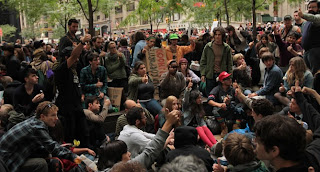
On Saturday, September 17th, many of us watched in awe as 5,000 Americans descended on the financial district of Lower Manhattan, waved signs, unfurled banners, beat drums, chanted slogans and proceeded to walk toward the “financial Gomorrah” of the nation. They vowed to “occupy Wall Street” and to “bring justice to the bankers,” but the New York police thwarted their efforts temporarily, locking down the symbolic street with barricades and checkpoints. Undeterred, protesters walked laps around the area before holding a people’s assembly and setting up a semi-permanent protest encampment in a park on Liberty Street, a stone’s throw from Wall Street and a block from the Federal Reserve Bank of New York.
Three hundred spent the night, several hundred reinforcements arrived the next day and as we write this article, the encampment is rolling out sleeping bags once again. When they tweeted to the world that they were hungry, a nearby pizzeria received $2,800 in orders for delivery in a single hour. Emboldened by an outpouring of international solidarity, these American indignados say they’ll be there to greet the bankers when the stock market opens on Monday. It looks like, for now, the police don’t think they can stop them. ABC News reports that “even though the demonstrators don’t have a permit for the protest, [the New York Police Department says that] they have no plans to remove those protesters who seem determined to stay on the streets.” Organizers on the ground say, “We’re digging in for a long-term occupation.” Now the world is watching and wondering: Could this be the spark of a “Tahrir Moment” in the USA?
#OCCUPYWALLSTREET was inspired by the people’s assemblies of Spain and floated as a concept by a double-page poster in the 97th issue of Adbusters magazine, but it was spearheaded, orchestrated and accomplished by independent activists. It all started when Adbusters asked its network of culture jammers to flood into Lower Manhattan, set up tents, kitchens and peaceful barricades, and occupy Wall Street for a few months. The idea caught on immediately on every social network, and unaffiliated activists seized the meme and built an open-source organizing site. A few days later, a general assembly was held in New York City and 150 people showed up. These activists became the core organizers of the occupation. The mystique of Anonymous pushed the meme into the mainstream media. Their video communique endorsing the action garnered 100,000 views and a warning from the Department of Homeland Security addressed to the nation’s bankers. When, in August, the indignados of Spain sent word that they would be holding a solidarity event in Madrid’s financial district, activists in Milan, Valencia, London, Lisbon, Athens, San Francisco, Madison, Amsterdam, Los Angeles, Israel and beyond vowed to do the same.
There is a shared feeling on the streets around the world that the global economy is a Ponzi scheme run by and for Big Finance. People everywhere are waking up to the realization that there is something fundamentally wrong with a system in which speculative financial transactions add up, each day, to $1.3 trillion (50 times more than the sum of all the commercial transactions). Meanwhile, according to a United Nations report, “in the 35 countries for which data exist, nearly 40 per cent of jobseekers have been without work for more than one year.”
“CEOs, the biggest corporations and the wealthy are taking too much from our country and I think it’s time for us to take back,” says one activist who joined the protests last Saturday. Jason Ahmadi, who traveled in from Oakland, California, explained that “a lot of us feel there is a large crisis in our economy and a lot of it is caused by the folks who do business here.” Bill Steyerd, a Vietnam veteran from Queens said, “It’s a worthy cause because people on Wall Street are blood-sucking warmongers.”
There is not just anger. There is also a sense that the standard solutions to the economic crisis proposed by our politicians and mainstream economists – stimulus, cuts, debt, low interest rates, encouraging consumption – are false options that will not work. Deeper changes are needed … like a “Robin Hood” tax on financial transactions; reinstating the Glass-Steagall Act in the USA; implementing a ban on high frequency “flash” trading. The “too big to fail” banks must be be broken up, downsized and made to serve the people, the economy and society again. The financial fraudsters responsible for the 2008 meltdown must be brought to justice and given lengthy prison terms. Then there is the long-term mother of all solutions: a total rethinking of Western consumerism that throws into question how we measure progress.
If the current economic woes in Europe and the US spiral into a prolonged global recession, then people’s encampments will become permanent fixtures in financial districts and outside stock markets around the world. Until our demands are met and the global economic regime is fundamentally reformed, our tent cities will keep popping up everywhere.
Bravo to those courageous souls in the encampment on New York’s Liberty Street. Every night that #OCCUPYWALLSTREET continues will escalate the possibility of a full-fledged global uprising against business as usual.
A different draft of this article was published by the Guardian online.