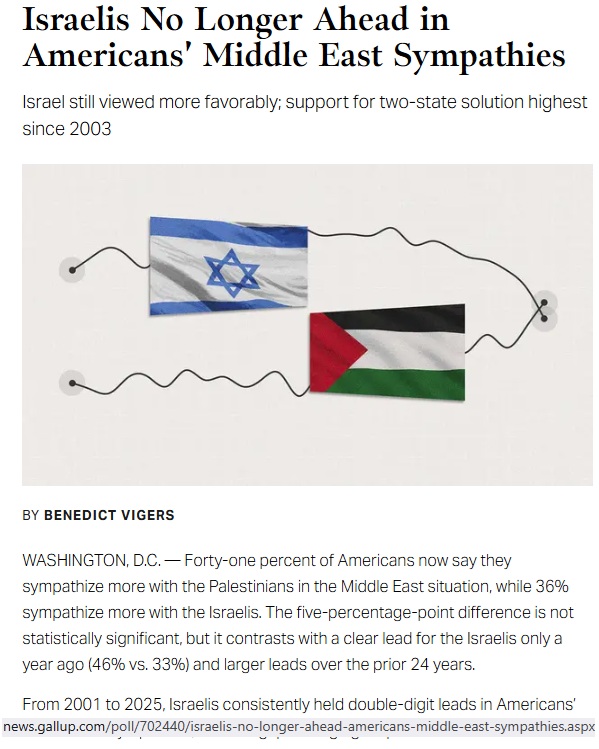
A Historic Shift: US voters sympathize more with Palestinians than Israelis for first time

In a notable departure from decades of consistent polling data, American public opinion on the Middle East conflict has reached a turning point. For the first time in more than twenty years, a greater share of U.S. adults express sympathy for the Palestinian people than for Israel, signaling a profound evolution in the nation’s political Read more

Continue Reading

Trump’s “Mission Accomplished” Moment

How the Iran Nuclear Pretext Reveals a Broader Agenda of Coercion In the annals of modern geopolitical theater, few phrases carry as much ironic baggage as “mission accomplished.” Eight months after the United States launched airstrikes on Iranian nuclear facilities under the codename “Operation Midnight Hammer,” President Donald Trump finds himself in a rhetorical loop: Read more

Continue Reading

The US Dollar: From Economic Powerhouse to Political Weapon

Abstract This article explores the historical rise and multifaceted dominance of the US dollar, tracing its evolution from a national currency to a global economic and political instrument. Backed by America’s economic might, military power, institutional stability, and technological leadership, the dollar has long stood at the center of the international financial system. It examines Read more

Continue Reading

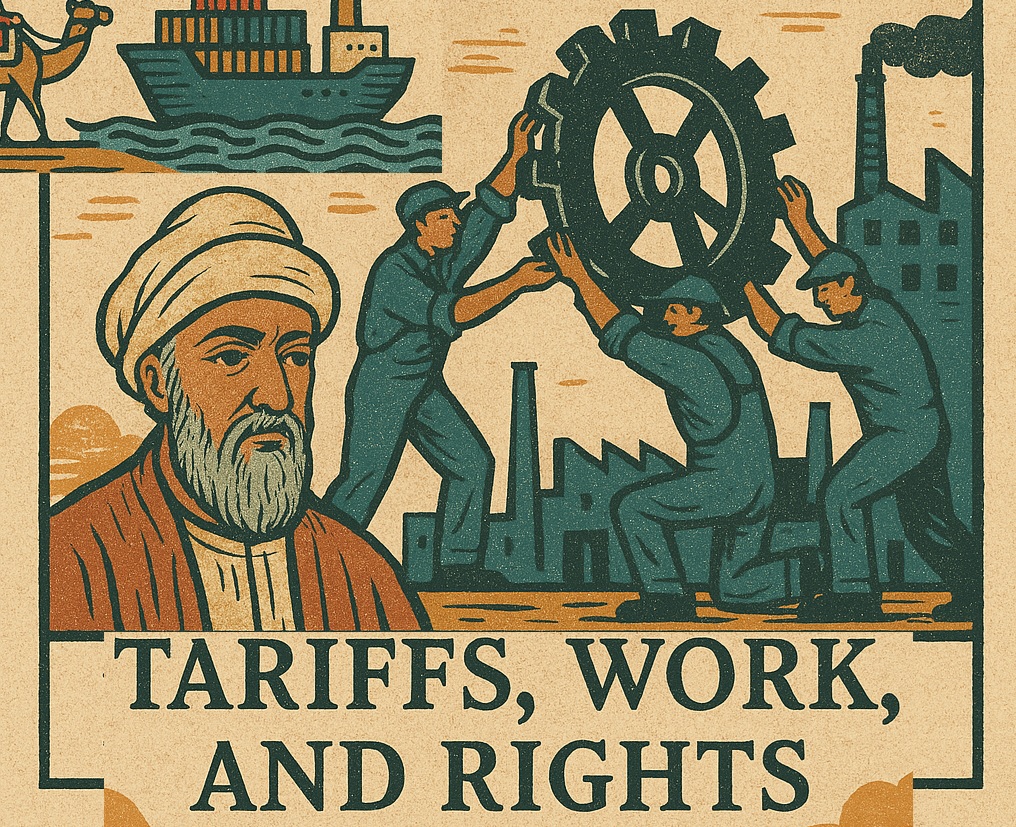
Tariffs, Work, and Rights

Abstract: This article reexamines economic justice through the lens of Islamic civilization, contrasting its moral and labor-centered foundations with the capital-driven structures of modern Western economies. Prompted by a significant current event—newly announced sweeping tariffs imposed by the U.S. administration on all imported goods, some at historically high rates—this analysis considers how tariff policy is Read more

Continue Reading

The Interconnectedness of Events in Syria, Turkey, and SWANA

What happens in SWANA will not Stay in SWANA by Ahmed Souaiaia Abstract: The ongoing crises in Syria and Turkey are deeply intertwined with broader regional dynamics, including the ongoing instability in the Southwest Asia and North Africa (SWANA) region. This article analyzes these events through the lens of the Systems Thinking Framework (STF), which Read more

Continue Reading

Algeria’s intractable neutrality in the context of global polarization

by Hossam Hamza Algeria’s constant insistence on embedding the principles of non-alignment and positive neutrality in its foreign policy expresses its realization of the intractability of understanding the pattern of its dealing with the dynamics of polarization at the level of the international system. It is intended to achieve the aspirations of the party making Read more

Continue Reading

Why would China put its prestige on the line by proposing a peace plan for the War in Ukraine that they know will be rejected by NATO?

Hours after China announced its proposal regarding the situation in Ukraine, NATO’s chief, Jens Stoltenberg, rejected it saying by invoking the lack of trust. “First of all, there is not much trust in China since they could not condemn Russia’s invasion. And they signed an agreement on unlimited friendship with Russia before the invasion.” The Read more

Continue Reading
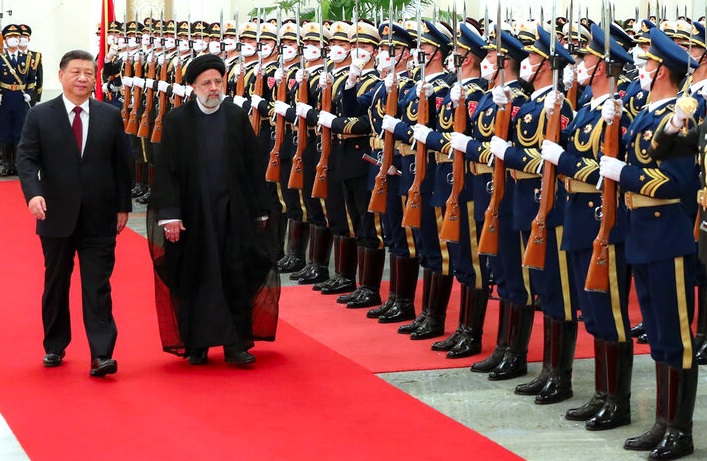
Raisi and Xi in China

Where is Iran’s position in the Russian war against NATO?

by Emad Abshenass * When the former Soviet Union collapsed, and the eastern bloc called the “Warsaw Pact” collapsed, there was hope to end the role of the North Atlantic Treaty Organization (NATO) and start a new era of international relations, based on dealings between countries instead of hostility, with the starting point of competition Read more

Continue Reading