
By Ahmed E. Souaiaia, PhD*
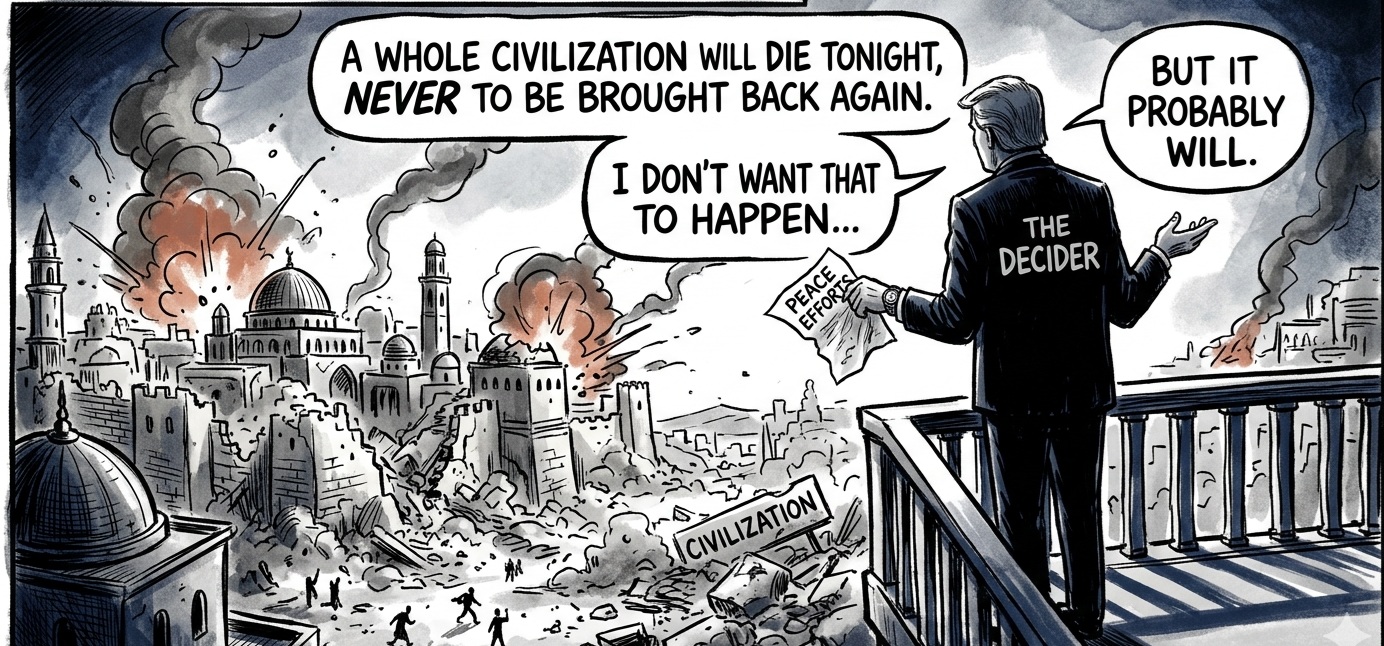
“A whole civilization will die tonight, never to be brought back again. I don’t want that to happen, but it probably will.”
These words, posted by US President Donald Trump on Truth Social, were more than a threat—which they were directed against Iran which he attacked without congressional authorization or UNSC resolution. They were a declaration. And whether intended as rhetorical bluster or strategic coercion, their systemic consequence is independent of motive: they exposed a rupture in the conceptual architecture that has, for seven decades, provided the moral and legal framework of the modern Western-led international order.
This article does not debate intent. It applies a systems-thinking framework—grounded in historical theory and observable political reaction—to analyze what occurs when the practical instruments of power detach from the conceptual values that legitimize them. The result is a visible rupture.
By “civilization,” this analysis does not refer to multiple parallel cultural formations, but to the dominant system of human association that organizes global social, legal, and economic life. In an interconnected world, there is effectively one such civilization at a time, shaped by the power that sets the terms of interaction for the rest. Other societies contribute cultures, but do not constitute separate civilizations in this systemic sense. In this sense, what is commonly called “Western civilization” is not one culture among others, but the current global civilizational order, historically structured and led by Western powers, particularly the United States over the past seventy years.
Trump’s post came hours before a self-imposed deadline for Iran to reopen the Strait of Hormuz. In it, he threatened the destruction of bridges, power plants, and “everything that makes them a country.” He described the Iranian people with dehumanizing language. And then, the culminating line: a whole civilization will die tonight, never to be brought back again.
Regardless of how “a civilization” is defined—and whether it can be distinguished from a “culture”—we know from enduring historical records and time-tested theories on human association that no civilization endures indefinitely. Ibn Khaldun explained this systematically more than six centuries ago: civilizations rise through the alignment of their internal bonds and organizing principles, and decline when those bonds weaken and their governing logic becomes increasingly reliant on force.
To be a civilization, a dominant social group, nation, or collection of nations must develop a conceptual framework—a worldview based on a set of values and principles—and embed that framework in its practical systems. Together, the conceptual and the practical launch such a human association to higher levels of achievement. But these same systems, when they fall out of alignment, set the path to decline and ultimate replacement.
The modern Western civilization—conceptualized and realized by Western nations and, in the last seventy years, instrumentalized by the United States—has been built upon a worldview centered on rule of law, human rights, and justice. Whether that centering has been genuine is not the concern here. What matters is the functional alignment between what is professed and what is practiced.
What is happening now before our eyes is a visible break in that alignment.
Some reacted to Trump’s statement narrowly: as a threat against Iran, as abusive rhetoric, as political excess. But within a systems framework, the statement operates at a different level. It is not merely directed outward; it reflects inward. It reveals that the distinction between civilian and military targets, between proportionality and excess, between lawful force and total destruction—long central to the moral and legal grammar of the current civilization—can be openly discarded at its center.
For history, and based on history, such moments matter. Not because they cause decline, but because they make it visible.
In this analysis, the “death” of a civilization does not denote its immediate disappearance. It marks the moment at which the alignment between its conceptual and practical systems is broken in a way that signals the beginning of its terminal, though often prolonged, decline. Civilizations do not vanish overnight; their decline is slow, accretive, and cumulative. But there are rare moments when that trajectory becomes identifiable in real time.
This is such a moment.
When the center of gravity of a civilization openly abandons the worldview that provides the moral and legal grounding of its power, the path of decline is no longer concealed within gradual change. It is declared.
The reactions from within the American political system are the system’s immune response to a pathogenic rupture. When allies break ranks to say “that is not who we are,” when conservative voices describe the rhetoric as vile, when military leaders reaffirm the duty to refuse unlawful orders—these are not partisan maneuvers. They are evidence that the conceptual framework still persists among those who inherited it.
But an immune response cannot, by itself, restore alignment. It can only signal that damage has occurred.
The fact that dissent emerges from within the center itself confirms the severity of the rupture: the grammar of the system is no longer universally legible, even to its most powerful speaker.
Therefore, irrespective of whether such threats are carried out, the declaration itself is consequential. It signals an abandonment of the conceptual system that has long provided legitimacy to the exercise of power. It is not a deviation within the civilization; rather, it is a negation of one of its foundational premises.
Civilizations decline not only through external pressure, but through internal disjunction—when what they profess and what they practice can no longer be reconciled. This is the pattern observed across history and anticipated in the work of Ibn Khaldun: the center, once the source of cohesion, becomes the site of rupture.
To say that a civilization died today is not to say that tomorrow it will cease to exist. It is to say that a threshold has been crossed—a point at which the alignment that sustained it has been publicly severed. What follows is not immediate collapse, but a prolonged period of erosion: of legitimacy, of trust, and of the capacity to organize human cooperation on the scale it once did.
New social groups will eventually rise. New conceptual frameworks will emerge. This has always been the course of human history. But the transition is rarely peaceful. It unfolds through ambiguity, instability, and contestation.
Until then, we inhabit the aftermath of a declaration—one that did not begin the decline, but made it unmistakably visible.
The statement was vile. The consequence is structural: a civilization, defined by the alignment of its conceptual and practical systems, has entered its terminal phase.
A civilization died today. But it was not the Iranian civilization.
* Prof. Souaiaia is a member of the faculty at the University of Iowa. His most recent publication, The Systems Thinking Framework, bridges Islamic classical and modern thought in the discourse on rights.