
 |
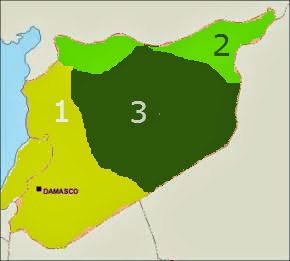
| Future of Syria: not bringing this crisis under control now could divide Syria along ethnic and sectarian fault lines. |
Since 2012, many observers and scholars familiar with the Syrian crisis have advised against arming Syrian rebels and warned about the risks of turning that country into a powder keg, endangering peace in that volatile region. Those early predictions are now a reality. Reacting to recent developments, U.S. and British officials announced that they are suspending delivery of aid to Syrian rebels when the Free Syrian Army’s depots were overrun by al-Qaeda affiliates. Video footage shows that the Free Syrian Army had actually received more than “non-lethal aid.” Rebels fighters claims that they found anti-aircraft weapons, sophisticated guns, and munitions.
Anticipating or reacting to these developments, Saudi Arabia, through groups it funds, launched a determined (but failed) attack on Damascus’ east Ghutah, Turkey closed some of its border crossings with Syria, and leaders of the Free Syrian Army fled to Europe, Turkey, and Qatar.
Importantly, armed rebels reorganized themselves into new coalitions (Army of Islam and Islamic Front) and withdraw their membership in the Syrian National Coalition of Syrian Revolution and Opposition Forces, a political organization Saudi Arabia and some Western countries have recognized as the sole “legitimate” representative of the Syrian people. These astounding developments are revealed just six weeks before an international meeting, Geneva-2, that is supposed to force the Syrian government and opposition to find a political solution to a brutal conflict, which killed more than 110,000 people from both sides, displaced nearly five million people, and destabilized Iraq, Lebanon, Turkey, and Jordan.
The handling of the Syrian crisis is revealed policies that were dictated by short term political gains, ulterior motives, and/or on the faulty grounds. Syria’s initially peaceful protest movement was hijacked and militarized by regional and world state actors. The cost of such an ill-advised adventure did not just destroy Syria, but it produced dangerous conditions for the entire world. The Syrian crisis, if allowed to spiral out of control will have repercussions on all those who enabled and supported violence in Syria. Notwithstanding these conditions, all parties have a window of opportunity to stop this cycle of cruelty: the partners in destruction need to take full responsibility and build a partnership for peace to help Syria overcome hatred and exclusion and work towards reconciliation.
____________
* Prof. SOUAIAIA teaches at the University of Iowa. His most recent book, Anatomy of Dissent in Islamic Societies, provides a historical and theoretical treatment of rebellious movements and ideas since the rise of Islam. Opinions are the author’s, speaking on matters of public interest; not speaking for the university or any other organization with which he is affiliated.