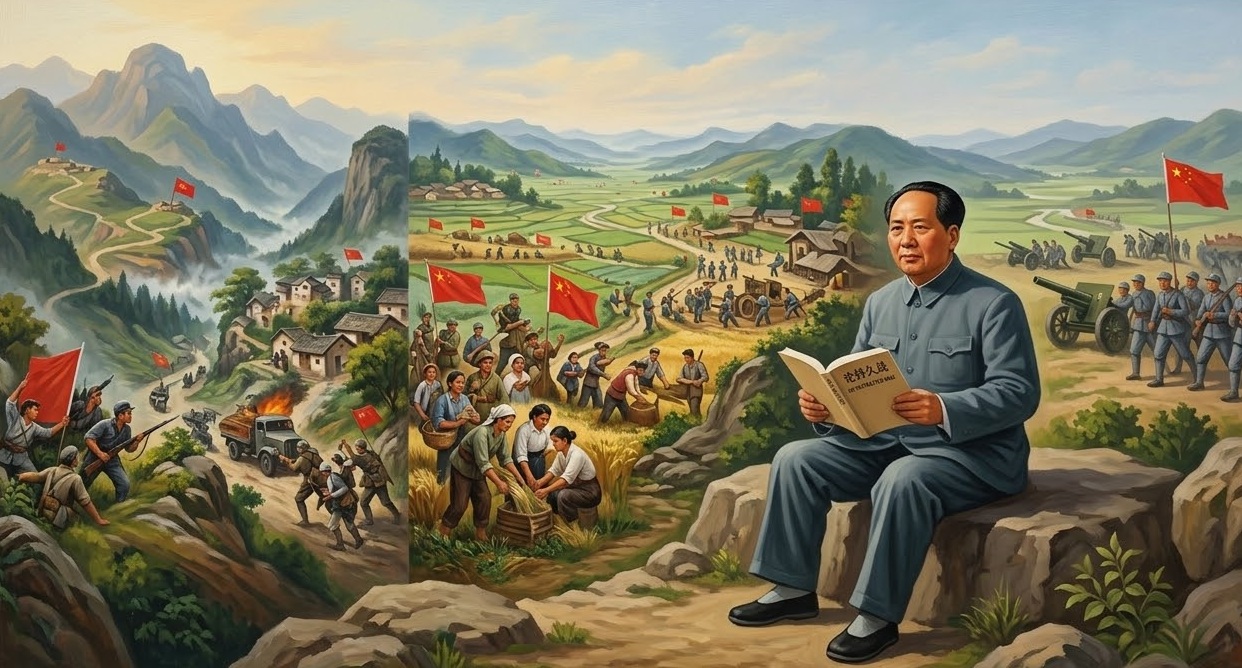
The Convergence of Maoist Protracted War Theory and Iranian Mosaic Defense Doctrine

Asymmetric Endurance Abstract In the contemporary landscape of geopolitical conflict, the disparity between conventional military power and asymmetric resistance has necessitated the evolution of strategic doctrines that prioritize endurance over immediate victory. This article examines the Iranian strategic framework known as “Mosaic Defense,” analyzing its structural and theoretical alignment with the classical principles of protracted Read more

Continue Reading

Why Military Superiority Cannot Secure US Victory in Iran

The Paradox of Power By Ahmed Souaiaia In the annals of modern conflict, a persistent fallacy plagues the strategic calculus of superpowers: the belief that kinetic dominance equates to political victory. As the United States and Israel engage in escalated hostilities against Iran, the Trump administration faces a stark reality that transcends the battlefield. While Read more

Continue Reading

The Political Instrumentalization of “Terrorism” and Sanctions in Contemporary Foreign Policy

The recent developments surrounding former jihadist Ahmed al-Sharaa—formerly known as Abu Mohammed al-Jolani—and his transformation from a wanted terrorist leader into a sitting president welcomed by the President of the United States illustrate a deeply troubling fact in international relations: the arbitrary use of the “terrorism” label and economic sanctions as tools of political convenience Read more

Continue Reading

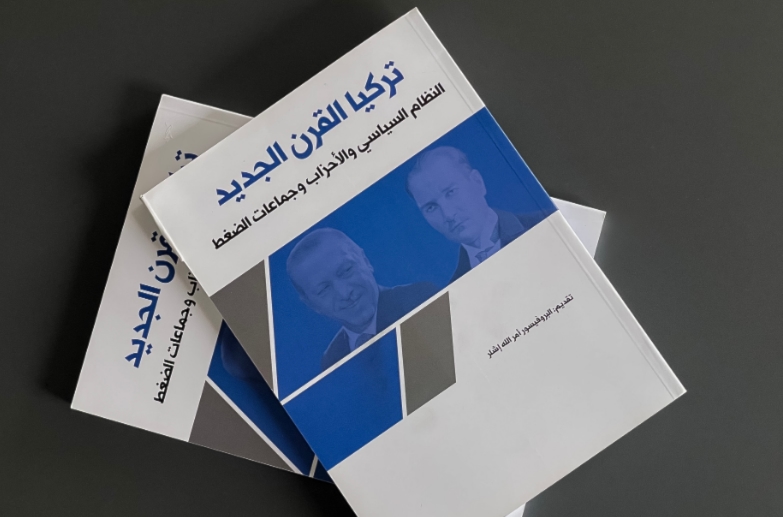
“Türkiye for the New Century”, Türkiye’s politics and parties

by Ali M. Shukr Recently published by the Institute for Future Studies in Beirut, the book “Turkey in the New Century: The Political System, Parties, and Pressure Groups,” was presented by Professor Emrullah Ashler, the former Deputy Prime Minister of Turkey. The book was divided into an introduction and 5 chapters. In each chapter, a Read more

Continue Reading

The rise of the Welfare Party: This is what the schizophrenia did to Erdogan

by Abdel Moneim Ali Issa In a meeting held last Wednesday with leaders of the Justice and Development Party, Turkish President Recep Tayyip Erdogan summarized the reasons that led to the party’s defeat in last week’s municipal elections, saying that what happened “was not only a loss of votes, but also a loss of blood.” Read more

Continue Reading

Algeria’s intractable neutrality in the context of global polarization

by Hossam Hamza Algeria’s constant insistence on embedding the principles of non-alignment and positive neutrality in its foreign policy expresses its realization of the intractability of understanding the pattern of its dealing with the dynamics of polarization at the level of the international system. It is intended to achieve the aspirations of the party making Read more

Continue Reading

The unpublished security clauses of the Iran-Saudi deal and its implication on regional and global security

The public statement that announced the deal between Iran and Saudi Arabia contains only the contours of a detailed deal whose terms are guaranteed by China and whose terms will be revealed gradually in the next few weeks. One such details concern the long terms security agreement as well as the immediate action to be Read more

Continue Reading

Turkish elections: Can Erdogan maintain his grip on power?

by Mohamad Hasan Sweidan * As the centenary of the founding of the Turkish Republic approaches, Turkiye faces one of the most important elections in its history. Most importantly, the upcoming parliamentary and presidential elections, currently slated for May, could lead to major shifts in the country’s foreign policy. But the February earthquakes that devastated Read more

Continue Reading

Why would China put its prestige on the line by proposing a peace plan for the War in Ukraine that they know will be rejected by NATO?

Hours after China announced its proposal regarding the situation in Ukraine, NATO’s chief, Jens Stoltenberg, rejected it saying by invoking the lack of trust. “First of all, there is not much trust in China since they could not condemn Russia’s invasion. And they signed an agreement on unlimited friendship with Russia before the invasion.” The Read more

Continue Reading