by Ahmed E. Souaiaia, Ph.D., University of Iowa
Introduction
We often speak of scientific discovery as if it were a series of sudden breakthroughs, authored by solitary minds in moments of inspiration. The story of human understanding, however, is neither sudden nor solitary. It is a slow, cumulative conversation across millennia—a relay in which each generation passes forward not final truths, but refined questions. Nowhere is this clearer than in the journey toward one of the most famous equations in history: E = mc². While Albert Einstein gave it mathematical precision in 1905, the intuition that matter and energy are deeply intertwined echoes through ancient philosophies, medieval metaphysics, and spiritual traditions long before the language of physics existed to formalize it. To recognize this continuity is not to diminish Einstein’s contributions, but to place it in its proper context: as a vital chapter in humanity’s ongoing effort to comprehend a reality that forever exceeds our models. True discovery, we find, demands not pride in arrival, but humility in participation.
The Ancient Echoes
Long before laboratories, particle accelerators, or differential equations, human minds across civilizations sensed that the tangible and the intangible were not separate realms, but expressions of a single, dynamic reality. What is remarkable is not that these ancient thinkers lacked our tools, but that despite this absence, they produced conceptual frameworks that resonate—sometimes strikingly—with discoveries made millennia later. Their insights were not primitive approximations waiting for correction; rather, they were sophisticated attempts to understand a universe that reveals itself differently to different modes of inquiry.
Seeking the One Behind the Many
In 6th-century BCE Greece, philosophers like Thales, Anaximander, and Heraclitus embarked on a radical project: to identify the archē—the fundamental principle or substance from which all things emerge. Thales proposed water; Anaximander, the boundless apeiron; Heraclitus, ever-changing fire. These were not mere guesses about material composition, but profound attempts to explain how the visible, differentiated world arises from a unified source capable of transformation.
Heraclitus, in particular, grasped something essential about the nature of reality: that change is not an accident but the very essence of being. His famous dictum—”no man steps in the same river twice”—was not poetic flourish but ontological insight. He understood that what appears stable is actually a process, a dynamic equilibrium of opposing forces in constant tension. This intuition that stability is a pattern of change, not its absence, shares a conceptual affinity with modern physics’ understanding that even “solid” matter is sustained by dynamic exchanges in underlying fields.
The pre-Socratics worked without telescopes, microscopes, or mathematical formalisms capable of describing subatomic processes. They asked, nonetheless, the right questions: What is the relationship between the one and the many? How does the invisible give rise to the visible? What principle governs transformation? Their answers were qualitative, speculative, and sometimes wrong in their specifics. But their methodological innovation—seeking natural explanations for natural phenomena, rather than attributing everything to capricious gods—laid the groundwork for all future scientific inquiry.
Qi as the Substance-Force of the Universe
In classical Chinese thought, the concept of qi represents perhaps the most sophisticated ancient analogue to a unified matter-energy framework. Qi was understood not as either matter or energy, but as the fundamental “stuff” of the universe capable of condensing into solid form or dispersing as breath, wind, vitality, or spirit. As one classical text explains, qi is “both the substance of matter and the energy force that moves it, existing as both a tangible “essence” and an intangible dynamic.”
This framework was embedded in a holistic cosmology that saw the universe as a living organism, with humans as microcosms reflecting the macrocosm. The Yijing (Book of Changes) described reality as perpetual transformation governed by the interplay of yin and yang—complementary forces whose dynamic balance produces all phenomena. Nothing was static; everything was in flux, cycling through phases of emergence, flourishing, decline, and return.
Chinese thinkers developed this understanding without particle accelerators or spectroscopes. They relied on careful observation of natural cycles, introspective practices, and a philosophical commitment to seeing patterns of relationship rather than isolated entities. Their goal was not prediction and control, but harmony and alignment with the cosmic order. In their recognition that what we call “matter” is simply a denser manifestation of a more fundamental, dynamic reality, they developed a conceptual framework that echoes themes later formalized differently with the quantum insight that particles are excitations of underlying fields.
Prakṛti, Puruṣa, and the Dance of Manifestation
The Sāṃkhya school of Indian philosophy, dating to the first millennium BCE, articulated a dualistic metaphysics that nevertheless described a dynamic process of manifestation. It posited two eternal principles: Puruṣa (pure consciousness, the silent witness) and Prakṛti (primordial nature, the dynamic matrix of matter-energy). Prakṛti was not inert stuff but a field of potentiality containing three fundamental qualities (guṇas)—sattva (lucidity), rajas (activity), and tamas (inertia)—whose interplay produces the entire spectrum of existence, from the subtlest mental phenomena to the grossest physical forms.
What is striking is that Prakṛti was described as both the material cause and the efficient cause of the universe—not a passive substance shaped by an external agent, but an active, self-transforming reality. The Sāṃkhya Kārikā states that Prakṛti evolves through a series of transformations (parināma), giving rise to intellect, ego, mind, senses, and the elements. This is not creation ex nihilo, but the unfolding of latent potentials into manifest forms.
Later Advaita Vedanta philosophers pushed further, proposing that the apparent duality of matter and spirit is ultimately illusory—that beneath the surface of differentiation lies a non-dual reality (Brahman) that is both existence (sat) and consciousness (cit). The world of forms is not separate from this ground but its expression, like waves are not separate from the ocean.
These frameworks were developed through contemplative inquiry, logical analysis, and scriptural interpretation—not experimental measurement. Their aim was soteriological: to liberate the individual from suffering by revealing the true nature of reality. In their description of a universe that is fundamentally dynamic, where form arises from formlessness and returns to it, where the observer and observed are ultimately not separate, they resonate deeply with quantum mechanics’ challenges to classical notions of objectivity and substance.
The Body-Soul Dynamic as Cosmic Principle
Medieval Islamic philosophers synthesized Greek, Persian, and Indian thought with Qur’anic revelation to produce one of the most sophisticated pre-modern accounts of the relationship between the material and the immaterial. Thinkers like Ibn Sīnā (Avicenna, 980-1037) and Mullā Ṣadrā (1571-1640) did not simply accept body-soul dualism as a static opposition; they articulated a dynamic, developmental relationship that conceptually parallels modern insights into how properties emerge through relationship and process.
Ibn Sīnā defined the soul (nafs) as “the first perfection of the natural organic body”—meaning it is the organizing principle that makes a body alive and functional. He, nonetheless, simultaneously argued that the soul is an incorporeal substance, independent of the body in its essence. His famous “Flying Man” thought experiment asked: if a person were suspended in air, deprived of all sensory input, would they still be aware of their own existence? Ibn Sīnā concluded yes—self-awareness persists even without bodily sensation, suggesting the soul’s independence while still acknowledging its intimate connection to the body it animates.
Mullā Ṣadrā went further with his doctrine of “substantial motion” (al-ḥarakat al-jawhariyya). He proposed that all substances, including the soul, are in constant flux—not just changing their accidental properties (like location or color) but transforming in their very essence. The soul, he argued, is “bodily in its origination but immaterial in its subsistence.” It begins in close association with the body, evolves through vegetative, animal, and rational stages, and can ultimately transcend material limitations while remaining connected to the body it governs.
What makes Mullā Ṣadrā’s contribution especially significant is that he transformed metaphysics from a philosophy of static substances into a philosophy of process. In his doctrine of substantial motion, existence itself is developmental: being is not fixed essence but continuous becoming. Every entity, from mineral to plant to animal to rational consciousness, exists within a graded continuum of transformation. Change is therefore not accidental to reality; it is reality’s very mode of existence. The universe is not composed of isolated objects merely interacting externally, but of relational processes unfolding through time. In this sense, Ṣadrā anticipated what contemporary systems thinking would later emphasize: that stability is often the temporary appearance of deeper dynamic processes operating beneath the surface of observation.
This process-oriented ontology also reframed the relationship between matter and immateriality. The soul was not viewed as a fully formed substance inserted into the body, but as an emergent reality developing through embodied existence. Being itself unfolded through degrees of intensity, refinement, and integration. Such a framework differs fundamentally from mechanistic models that reduce reality to inert components linked through external causation. Instead, Islamic philosophical traditions—particularly in the synthesis achieved by Mullā Ṣadrā—conceived existence as layered, developmental, and internally relational. The significance of this insight extends beyond theology or metaphysics. It offers a conceptual bridge between ancient philosophical reflection and modern systemic approaches that understand reality not as static structure, but as evolving networks of emergence, interdependence, and transformation.
Islamic philosophers described the body as “the state of hardness and heaviness” and the soul as “a degree of lightness and subtlety”—not as separate substances but as different modes of the same underlying reality. They recognized that the relationship between body and soul is not static but developmental, a process of mutual transformation. They lacked the mathematical tools to quantify this relationship or the instruments to observe it at microscopic scales. But through rigorous logical analysis, introspective practice, and engagement with both revelation and reason, they produced a framework that explores emergence, process, and the relational nature of reality in ways that remain philosophically resonant.
Wisdom Without Instruments
What unites these diverse traditions is their recognition that reality is fundamentally dynamic, that the visible emerges from the invisible, and that the observer cannot be fully separated from the observed. They arrived at these insights without particle colliders, radio telescopes, or quantum computers. They used different tools: careful observation of natural cycles, introspective meditation, logical deduction, poetic metaphor, and dialogical inquiry.
Their limitations were real. They could not calculate the energy yield of nuclear fusion or predict the half-life of radioactive isotopes. Their frameworks were often entangled with cosmological assumptions. Some of these assumptions—such as geocentrism, classical elemental theory, or vitalist accounts of life—proved incompatible with empirical evidence and were necessarily abandoned. They lacked the precision that comes from mathematical formalism and experimental verification.
This is where the epistemic relay shifted. The transition from qualitative contemplation to quantitative science was enabled not merely by inherited questions, but by new methodological infrastructure: mathematical formalism, controlled instrumentation, institutional peer review, and the principle of falsifiability. Where metaphysical traditions sought coherence, normative alignment, and soteriological insight, modern science prioritizes predictive accuracy, empirical constraint, and model-testing. Recognizing this distinction is crucial: conceptual resonance is not theoretical equivalence, and shared intuition does not replace the rigorous work of measurement. Yet the handoff remains genuine. The ancient thinkers were not wrong because they lacked our tools; rather, they asked foundational questions that made later answers possible. They provided conceptual vocabulary—archē, qi, prakṛti, nafs—that allowed later thinkers to articulate increasingly sophisticated models. They demonstrated that the pursuit of knowledge requires not only technical skill but also philosophical depth, ethical reflection, and a willingness to embrace mystery.
To dismiss their contributions as “pre-scientific” is to misunderstand the nature of discovery itself. Science does not emerge from a vacuum; it grows from the soil of human curiosity, shaped by the questions, metaphors, and conceptual frameworks inherited from the past. They saw that the universe is a unity expressing itself in multiplicity, that stability is a pattern of change, and that the tangible and intangible are in constant interplay. These insights remain true, whether expressed in the language of philosophy or the language of physics.
Precision Through Limitation
The leap from qualitative intuition to quantitative law required a different kind of insight: the courage to simplify. Einstein’s E = mc² is often presented as a universal declaration, but it is, in fact, a special case—a deliberately narrowed abstraction. The complete relativistic energy-momentum relation is E² = (pc)² + (mc²)², where p represents momentum. By setting p = 0, Einstein isolated the rest energy of a mass, creating a theoretical anchor that made the relationship intelligible. This “at rest” condition is not a claim about how the world actually behaves; it is a methodological bracketing, a spotlight held steady so that one facet of reality could be measured.
Abstraction works precisely because it leaves things out. Earlier thinkers like J.J. Thomson, Oliver Heaviside, and Henri Poincaré had glimpsed fragments of mass-energy equivalence, but only within electromagnetic contexts or ether-based models. Einstein’s breakthrough was universality: he derived the relationship from the symmetries of spacetime itself, showing that mass is condensed energy, not merely correlated with it. This precision, however, comes at a cost. The living, breathing world is never truly at rest. Atoms vibrate, cells metabolize, planets orbit, and galaxies expand. To apply E = mc² to reality is to approximate—to say, “For this moment, within this domain, we will treat motion as negligible.” The equation’s power lies not in its completeness, but in its disciplined focus and deliberate isolation.
Uncertainty as the Ground of Becoming
When we peer deeper, beyond the macroscopic scales where relativity holds sway, we encounter a reality that refuses to be pinned down. Quantum mechanics reveals that at the fundamental level, the universe does not operate through absolute exactitude, but through inherent uncertainty, relationality, and dynamic indeterminacy. Heisenberg’s uncertainty principle is not a limitation of our instruments; rather, it is a feature of nature itself. Position and momentum cannot simultaneously possess precise values because the quantum world does not possess them that way. Measurement is not passive observation; it is an interaction that participates in defining what becomes actual.
What ancient philosophers might have called the “unaccountable for” variable—the slight modification in balance that shifts potential into actuality—physicists now describe through quantum fluctuation, superposition, and the transition from probability to definite outcomes. (The precise ontological status of “wave-function collapse” remains interpretationally open, debated across decoherence theory, many-worlds, relational quantum mechanics, and other frameworks.) Regardless of interpretational stance, the formalism reveals an inherent indeterminacy that is not a flaw to be corrected; rather, it is the engine of emergence. It allows atoms to hold together, enables nuclear fusion in stars, and leaves room for genuine novelty in a universe that is fundamentally relational. Where classical physics sought certainty, quantum physics reveals a cosmos that is participatory, probabilistic, and alive with becoming. Precision, at this scale, gives way to probability; isolation gives way to entanglement. The dance continues, but the steps are no longer predetermined.
The Humility of the Continuum
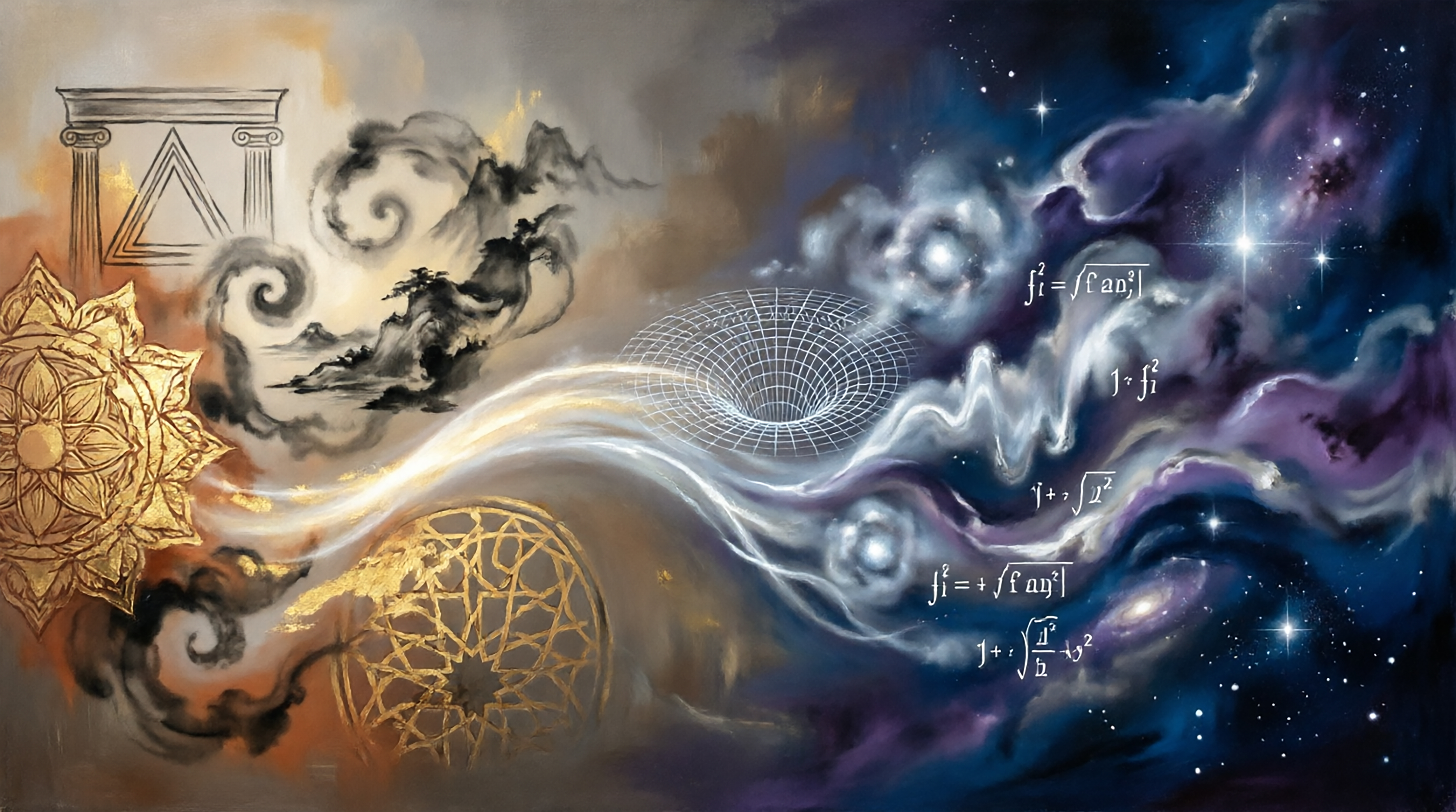
To trace this arc—from ancient intuition to relativistic abstraction to quantum indeterminacy—is to recognize a profound truth: no single framework captures reality in full. Each era’s contribution is a lens, not a mirror. The qualitative wisdom of antiquity saw the interconnectedness of all things; modern physics mapped its measurable contours; quantum theory revealed its inherent openness. Each built upon the questions, metaphors, and partial insights of those who came before, and each will one day be seen as a stepping stone by those who follow.
This should instill in us a deep humility. The equations we derive today, no matter how elegant, are abstractions born of domain restriction and tool-dependent observation. They are intelligible precisely because they are incomplete. Future generations will undoubtedly develop new mathematics, new instruments, and new ways of “seeing” that will render our current models provisional. This is not a failure of science; it is its very lifeblood. Discovery is not a monument to be erected, but a relay to be run. The ancient thinkers, working without microscopes or particle colliders, produced knowledge that resonates with our deepest findings not despite their lack of precision, but because they attended to reality with reverence, curiosity, and an openness to mystery.
Conclusion
If we are to honor the legacy of those who came before us, we must resist the temptation to treat discovery as ownership. E = mc² did not emerge from nothing; it crystallized centuries of quiet wonder. The quantum world did not appear from a vacuum; it answered questions shaped by metaphysical intuition and mathematical daring. And the theories we craft today will one day be the “ancient echoes” of tomorrow’s scholars.
This continuity should remind us that humility is not the opposite of ambition, but its necessary companion; to pursue knowledge with rigor is to acknowledge its limits; to build with precision is to honor the abstraction that makes it possible; and to look forward with aspiration is to accept that we, too, are participants in an unending conversation—one that stretches from the first human who gazed at the stars and sensed a hidden unity, to the last who will refine our equations into new forms of understanding. The universe does not yield its secrets to those who claim to possess them, but to those who remain willing to listen, to question, and to pass the light forward.