
Why Land Routes Build Empires
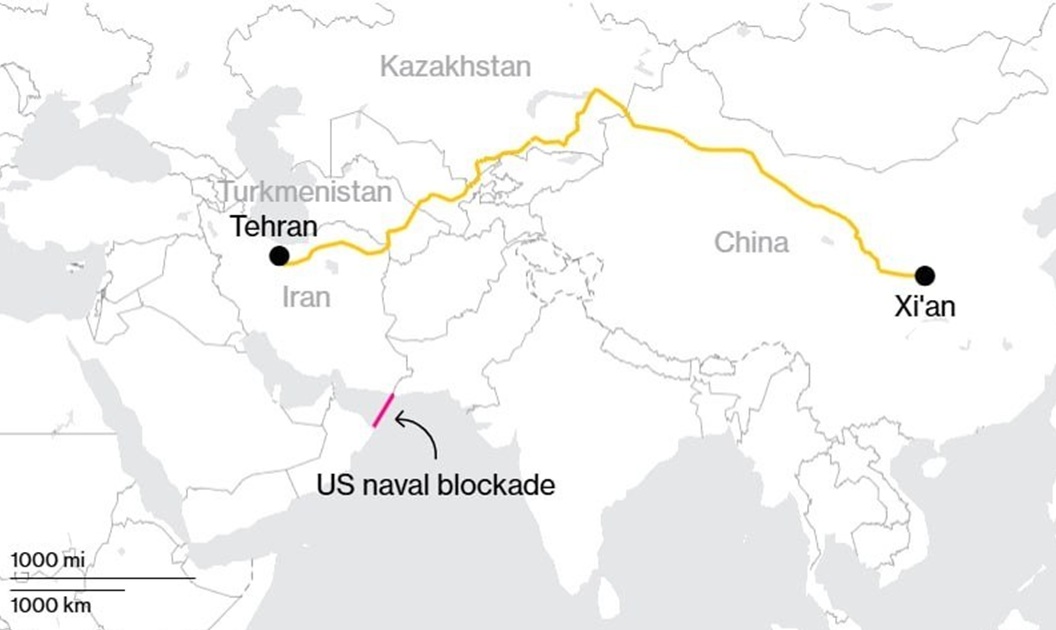
Trace the yellow line from Xi’an to Tehran, and you are not merely looking at a modern infrastructure project—you are witnessing the resurrection of an ancient truth that shaped civilizations for two millennia. Throughout history, the great cities of the Silk Road did not rise because of what lay beneath their soil, but because of what passed through their gates. Samarkand possessed no great mineral wealth, yet it became one of the world’s most magnificent cities because caravans had no choice but to pass through it. Bukhara, Kashgar, Merv, and Palmyra all followed the same pattern: they were not endpoints but passages, not producers but facilitators, and that made them richer than kingdoms with abundant natural resources.
This is the profound lesson embedded in the Belt and Road Initiative’s overland corridor, and it explains why this route represents a fundamentally more stable and powerful vision than maritime trade. Watch how the yellow line breathes life into each city it touches. Xi’an, once the terminus of the ancient Silk Road, is being reborn not as a manufacturing center but as a logistics nexus where goods from across China are consolidated for the journey west. Urumqi, isolated in China’s far west, transforms from a remote outpost into an indispensable gateway. Almaty, sitting astride the route through Kazakhstan, becomes a banking and services hub. Ashgabat gains strategic relevance far beyond Turkmenistan’s gas fields. Tehran secures its economic lifeline independent of the Persian Gulf.
None of these cities are wealthy because of what they export. They are becoming wealthy because of what they facilitate. This is the multiplier effect that maritime routes can never replicate. A ship leaving Shanghai for Bandar Abbas enriches only its origin and destination, sailing past intervening coastlines without leaving a trace of prosperity. But a train traveling the Silk Road Economic Belt creates a corridor of wealth, a ribbon of development that transforms every settlement along its path. Transit fees flow into government coffers. Warehouses and sorting facilities create employment. Hotels and restaurants serve the travelers and traders. Financial and insurance services cluster near the route. Manufacturing plants spring up nearby to minimize transport costs. The prosperity radiates outward from the tracks themselves.
And here lies the strategic brilliance that the original map reveals with stark clarity. That pink line labeled “US naval blockade” near the Strait of Hormuz is not a hypothetical concern—it is the Achilles’ heel of maritime dependence etched into geography. Sea routes are hostage to choke points: Hormuz, Malacca, Bab el-Mandeb, Suez, Panama. Narrow passages where a handful of warships can strangle the economic lifeblood of nations. The great maritime powers have understood this for centuries, which is why they built naval bases at these precise locations. But how do you blockade a railway that runs through the heart of a continent? You would need to invade Kazakhstan, occupy Turkmenistan, and conquer Iran—not simply position destroyers at a strait. The land route is not immune to disruption, but it is immune to the kind of surgical strangulation that naval powers have wielded so effectively for five hundred years.
This is why the historical pattern matters. Venice and Genoa did not become wealthy from Italian natural resources; they became wealthy because they controlled the termini of Silk Road trade into Europe. The Hanseatic League cities prospered not from what they produced but from what they transported. Singapore, sitting astride the Malacca Strait, transformed from a malaria-infested swamp into one of the world’s richest nations because ships had to pass by. Position, not endowment, creates lasting wealth.
The Belt and Road Initiative understands this at a civilizational level. By building this overland corridor, China is not simply creating an alternative trade route—it is constructing a geopolitical reality that cannot be undone by naval maneuvers. Every country along the route now has a vested interest in its success. Kazakhstan’s economy is increasingly tied to its role as a transit state. Iran’s access to Chinese markets no longer depends on American goodwill in the Persian Gulf. Central Asian nations, long landlocked and marginalized, are becoming land-linked and essential. This creates a web of mutual interdependence far more resilient than the hub-and-spoke system of maritime trade centered on American-controlled sea lanes.
The historical Silk Road eventually declined, not because it was blockaded, but because maritime routes became cheaper and faster. But the calculus has changed. Rail technology has improved, infrastructure investment has reduced friction, and the strategic cost of maritime dependence has become unbearable for nations seeking autonomy. More importantly, the overland route offers something ships never could: the transformation of empty space into economic space, of remote towns into thriving cities, of isolated nations into connected partners.
This is the long game. While maritime routes concentrate wealth in coastal entrepôts and leave intervening territories impoverished, the Silk Road Economic Belt distributes prosperity across an entire continent. While sea lanes remain vulnerable to the whims of naval powers, land routes create facts on the ground—railway stations, logistics hubs, industrial parks—that embed themselves into the economic landscape for generations. While maritime trade enriches only the endpoints, overland trade creates a corridor of development that lifts entire regions.
The yellow line on the map is more than infrastructure. It is a statement that the geography of the twenty-first century will not be determined by who controls the seas, but by who builds the bridges, lays the tracks, and connects the cities. Samarkand rose from the desert because caravans passed through. The cities along this new Silk Road are rising again for the same reason. And that is a form of power that no blockade can touch.
