
Introduction
Recent commentary in policy and journalistic circles, typified by essays such as The New York Times piece titled “America Is Officially an Empire in Decline,” interprets the contemporary geopolitical moment through the lens of strategic errors, imperial overreach, and episodic miscalculation. Within this framing, hypothetical or proximate conflicts, including discursive references to the 2026 war on Iran, are positioned as decisive inflection points that accelerate or reveal systemic deterioration. Such accounts capture visible strain but remain analytically confined to event-centric and state-centric logics. They presuppose that decline is triggered rather than emergent, that empire is an attribute of a nation-state rather than a structural condition of a broader configuration, and that capacity, whether military, economic, or technological, constitutes the primary metric of systemic vitality. When examined through the historical-sociological framework of Ibn Khaldun, integrated with contemporary systems thinking framework, each of these assumptions proves incomplete. They mistake manifestation for causation, scale for structure, and output for coherence.
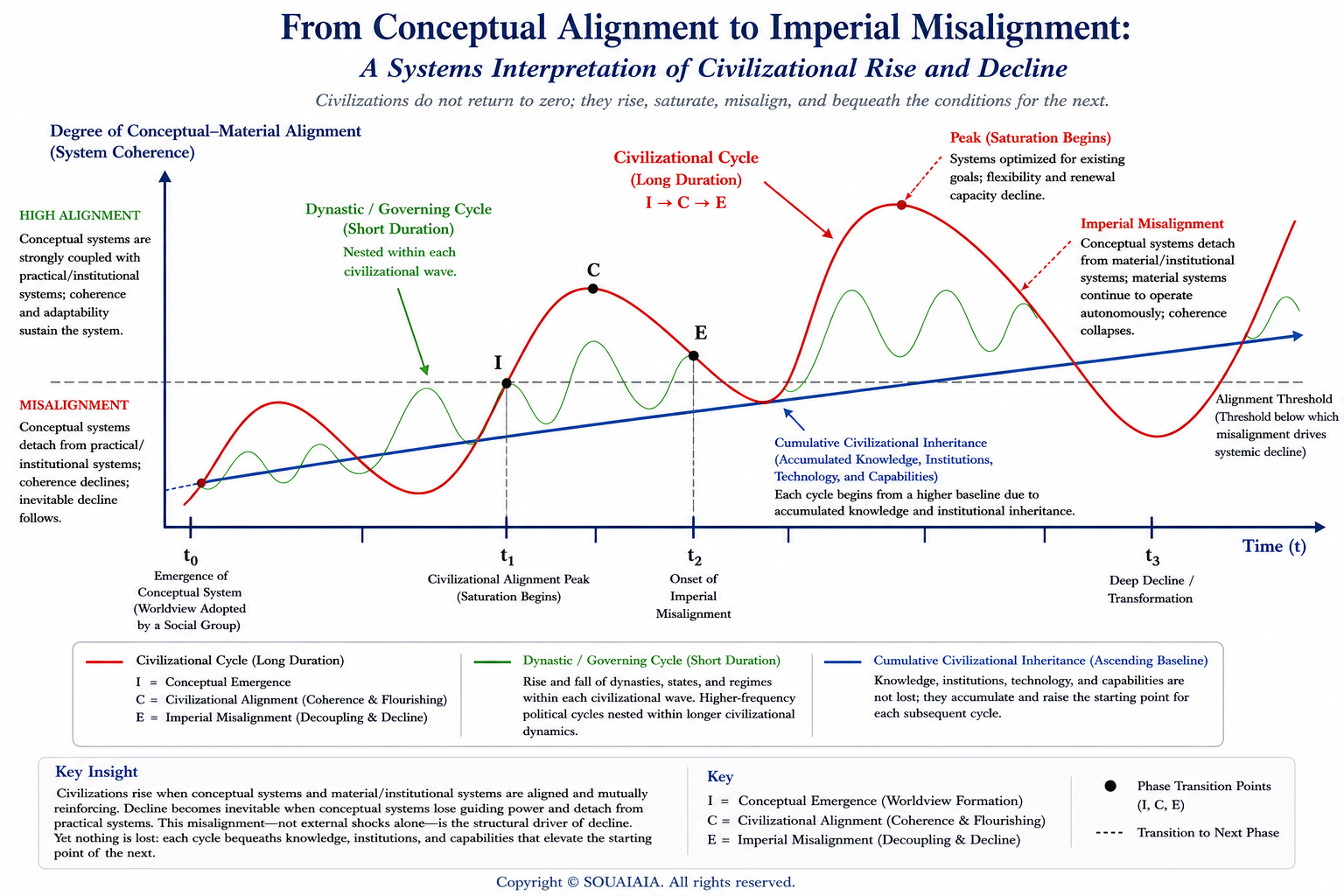
This essay advances three interrelated corrections. First, it displaces the nation-State as the unit of analysis, arguing that what is colloquially termed “American power” is better understood as the latest concentration of power within a civilizational formation that predates the United States and will likely outlast its hegemonic phase. Second, it reconceptualizes empire not as territorial expansion but as a structural misalignment between conceptual systems and praxeological systems, a decoupling that occurs as institutional complexity outpaces social cohesion. Third, it introduces the concept of systemic completion to explain why late-stage configurations appear simultaneously powerful and incoherent: They have achieved maximal functional output, after which internal feedback structures prioritize continuation over adaptation. The visible crises of the present are not the origin of decline but the legible outputs of a configuration that has exhausted its adaptive capacity. Recognizing this shifts the analytical focus from episodic collapse to civilizational transition, from capacity metrics to alignment diagnostics, and from state succession to systemic reconfiguration.
I. The Civilizational versus State-Centered Ontological Error
Contemporary decline narratives routinely treat the United States as a discrete civilizational entity whose fortunes rise and fall in linear correspondence with its geopolitical and economic indicators. This framing commits a categorical error. Ibn Khaldun’s historical sociology does not equate civilization with the state. Rather, it treats political authority as a temporary vessel for a broader civilizational formation, sustained by what he termed `asabiyya: a cohesive social energy rooted in shared purpose, mutual obligation, and collective discipline. States emerge when `asabiyya (ʿaṣabiyya) is institutionalized; they decay when institutional complexity and specific group-centered interests dilute cohesion. The civilizational formation, however, persists across changing political centers, adapting its conceptual core while shedding exhausted administrative structures.
What is commonly labeled American civilization is more accurately the contemporary apex of a broader formation that crystallized during the European Enlightenment, consolidated through liberal-capitalist institutionalization, and diffused globally via legal norms, educational architectures, financial networks, and cultural templates. The United States did not originate this system; rather, it inherited, intensified, and operationalized it. Earlier hegemonic centers, most notably Britain in the nineteenth and early twentieth centuries, performed analogous functions: projecting institutional models, underwriting global exchange, and stabilizing normative expectations across diverse peripheries. The apparent succession of dominant actors reflects not the rise and fall of discrete civilizations, but shifts in the center of gravity within a single, evolving civilizational matrix.
This distinction carries substantial analytical weight. When the State (dawla) is mistaken for the civilization (ḥaḍāra), scholars and commentators misattribute systemic dynamics to national policy choices. They read structural fatigue as leadership failure, institutional rigidity as political corruption, and global multipolarity as civilizational replacement. In reality, the mechanisms of civilizational expansion have rarely relied on sustained coercion. Their primary engine has been diffusion: the voluntary or structurally incentivized adoption of economic models, legal frameworks, bureaucratic practices, and cultural norms. What contemporary discourse terms soft power corresponds precisely to this capacity to reproduce systems without direct force. For much of the modern period, the strength of this formation lay in its ability to align normative claims (human rights, procedural legitimacy, rule of law) with institutional practices (`amal) that rendered those claims credible beyond their geographic core. When that alignment held, integration preceded coercion. When it fractured, coercion substituted for integration. The transition from civilizational formation to imperial configuration is not defined by borders or troop deployments; instead, it is defined by the erosion of normative credibility and the compensatory reliance on praxeological systems of power.
II. Conceptual–Praxeological Misalignment and the Structural Logic of Empire
The distinction between the conceptual and the praxeological is central to the present framework. The conceptual refers to the domain of meaning, explanation, justification, and teleological orientation through which a social group defines desirable outcomes and legitimizes action. The praxeological refers to the organized field of human action through which those conceptual commitments are enacted in institutions, behaviors, incentives, routines, and systems of social reproduction. Civilizational coherence depends on the alignment between these domains: Conceptual systems provide direction and legitimacy, while praxeological systems operationalize them in lived and institutional realities. Misalignment begins when praxeological systems continue to reproduce established patterns of action even after the conceptual framework (`asabiyya) that originally guided them has weakened or lost coherence. It is this divergence between conceptual orientation and organized social practice that marks the structural transition from civilization to empire.
Empire, in this analytical paradigm, is a structural imbalance, not a territorial category. It emerges when the praxeological systems of a civilizational formation, military apparatuses, financial architectures, logistical networks, extractive bureaucracies, achieve operational autonomy from the conceptual systems that originally legitimized them. In earlier developmental phases, these domains are mutually reinforcing: Conceptual commitments guide institutional design, and institutional practices reproduce those commitments in observable outcomes. Legitimacy is demonstrated through predictable, equitable, and procedurally sound governance. Over time, however, the increasing complexity and technical efficiency of praxeological systems allow them to function with diminishing regard for their conceptual foundations. Bureaucracies optimize for output rather than purpose; financial instruments prioritize liquidity over productivity; and military doctrines emphasize readiness over deterrence credibility, where conceptual language persists, but it no longer constrains practice. In this setting, the conceptual system becomes decorative.
When examined through the Khaldunian principled thinking, this decoupling is neither sudden nor intentional. It is the cumulative product of institutional path dependence and efficiency-driven specialization. As organizations refine their capacity to coordinate work and concentrate resources, they develop tight feedback loops that reward behaviors producing immediate, measurable outputs. These loops privilege continuation over recalibration. When outcomes begin to diverge from stated values, the system does not readily correct; instead, it amplifies the very mechanisms generating the divergence. The Khaldunian principles of maxima and systems interconnectedness apply here: Maximal deterrence creates maximal deployment; maximal financialization results in maximal debt dependency; and maximal proceduralism produces maximal technocratic insulation. Consequently, the pursuit of efficiency, paradoxically, reduces optionality, and high-performing systems eliminate slack because slack appears wasteful under conditions of growth. However, slack is the structural prerequisite for adaptation. Its absence ensures that when environmental conditions shift, the system lacks the redundancy, diversity, or institutional flexibility required to reconfigure itself.
Ibn Khaldun echoed this dynamic long before the formalization of the Systems Thinking Framework (STF). He observed that ruling groups initially consolidate power through shared hardship, mutual dependence, and disciplined collective action. As success breeds prosperity, administrative complexity increases, urban centers grow extractive, and the original cohesion dilutes into patronage, rent-seeking, and performative legitimacy. The ruling elite substitutes coercion for solidarity because the social energy that once sustained voluntary compliance has been exhausted by institutional luxury. The state continues to function, even expands, but its internal logic shifts from integrative to extractive. This is transformation–not collapse and it happens when the conceptual core becomes rhetorical and the praxeological apparatus becomes autonomous. What emerges, then, is empire in the structural sense: A configuration in which coercive and financial capacities compensate for diminishing normative integration.
III. Efficiency, Saturation, and the Trap of Maximalism
Contemporary accounts that locate decline in specific conflicts, fiscal thresholds, or diplomatic ruptures invert the causal order. The 2026 US war on Iran, European security crises, or supply chain disruptions are expressions of a configuration already operating at or near its functional limits. To understand why, it is necessary to examine the concrete mechanisms through which saturation manifests.
A military doctrine calibrated for global projection prioritizes rapid strike capacity, continuous forward deployment, and technological superiority. Under sustained engagement, this doctrine predictably depletes high-end munitions, strains maintenance logistics, and elevates the opportunity cost of readiness. A fiscal architecture designed to underwrite expansive commitments privileges debt-financed expenditure, monetized liabilities, and financialized growth. Over time, obligations accumulate faster than productive capacity, and servicing debt crowds out investment in human capital, infrastructure, and institutional renewal. A diplomatic posture oriented toward primacy incentivizes unilateral action, conditional alliances, and hierarchical partnerships. In response, peripheral actors hedge, rival coalitions coordinate, and the legitimacy of leadership thins. These patterns are the expected outputs of a system optimized for maximal reach, maximal speed, and maximal control (the Time Factor in systems thinking).
Within a systems framework, this trajectory can be expressed as the progressive organization of work and energy over time. As institutions refine the coordination of work, capital, and coercion, and concentrate energy in the form of resources, legitimacy, and belief, outputs increase and processes accelerate; efficiency rises. But efficiency carries a structural consequence: It compresses adaptive bandwidth. The system becomes exceptionally good at doing what it was designed to do, and increasingly incapable of doing anything else. Feedback loops that once enabled expansion now inhibit adjustment. Resources, incentives, professional identities, and institutional reputations are all aligned with existing outputs. Altering course would require dismantling the very mechanisms that define success within the system. In this precise sense, decline becomes functionally irreversible–not because alternatives are inconceivable, but because the system’s internal architecture and processes resist the reallocation of work and energy necessary to realize them.
This is why maximalism operates as a structural trap rather than a strategic choice. The pursuit of maximum deterrence, maximum reach, and maximum operational tempo elevates short-term outputs while driving the system toward saturation (as per Ibn Khaldun’s maxima principle). At saturation, marginal gains diminish while systemic costs compound. Crucially, the mechanisms that enabled dominance now generate rigidity. The system continues to produce impressive outputs, but coherence erodes; values are invoked but do not govern practice; military action substitutes for normative persuasion; financial instruments substitute for productive restructuring; and procedural claims substitute for substantive legitimacy. The language of civilization persists even as the operative logic shifts toward empire, toward the dominance of praxeological systems over the normative order that once integrated them.
IV. Khaldunian Dynamics and the Emergence of Post-Completion Orders
Against this backdrop, the common metrics of decline, stockpiles, debt-to-GDP ratios, battlefield outcomes, electoral volatility, prove analytically insufficient. They measure capacity, not coherence: A system can possess considerable capacity while undergoing structural transformation. The more decisive indicator is the degree of alignment between its normative-integrative systems and its praxeological systems. Where alignment persists, adaptation remains possible. Where it has eroded and feedback loops reinforce existing outputs, the system approaches completion.
Ibn Khaldun’s contribution is to render this process intelligible without reducing it to contingency or moral decay. He does not deny the importance of events; rather, he situates them within a longer developmental arc. Civilizational formations emerge through cohesion and disciplined work, expand through institutionalization, and reach a phase of optimization in which their systems achieve maximal efficiency. It is at this point, precisely at the peak of success, that reversal becomes structurally likely. The mechanisms that produced strength now generate rigidity; the pursuit of established goals crowds out alternative configurations; the system continues to act, but its actions deepen the imbalance. Completion, in this sense, is not failure; rather, it is the logical terminus of a specific conceptual–praxeological configuration.
What follows completion, however, cannot be predicted with precision. The dissolution of a configuration is far more legible than the emergence of its successor. New orders arise from reconfigurations of work and energy under different conditions emerging over time, often at the periphery of the existing system or in domains it systematically undervalues. They are not fully visible until they stabilize, accumulate institutional density, and demonstrate replicable legitimacy. For this reason, it is analytically unsound to treat the present as a simple handoff from one dominant actor to another, or to assume that multipolarity implies civilizational succession. What is opening is not simply a vacancy of leadership but a space for reorganization in a very complex reality. Emerging formations may draw selectively from the depleted civilizational matrix, hybridize its residual institutions with local normative frameworks, or bypass its structures entirely through technological, economic, or ecological adaptation. Their trajectories will be shaped less by the intentions of incumbent centers than by the distribution of slack, the reconfiguration of energy flows, and the restoration of cohesion at new scales.
This framework also clarifies why late-stage systems often appear simultaneously powerful and incoherent: Capacity remains substantial; outputs can still be generated at scale; however, alignment has eroded. The system speaks the language of its origins while operating according to the logic of its exhaustion. Policymakers mistake capacity for resilience, and commentators mistake volatility for collapse. Both errors stem from a failure to distinguish between the continuation of outputs and the coherence of the system producing them. When normative claims no longer constrain praxeological practices, the system enters a phase of performative governance: Institutions function, but legitimacy thins; procedures are followed, but outcomes diverge from stated purposes; and power is projected, but integration recedes. This is gradual decoupling, and it is precisely this decoupling that contemporary discourse misreads as imperial crisis rather than systemic completion.
V. Reframing Transformation Beyond the Decline Paradigm
The error in prevailing commentary, then, is not that it detects strain, but that it mislocates its source, misidentifies its scale, and misinterprets its trajectory. By treating empire as a national attribute, it obscures the civilizational formation within which that nation operates. By identifying a triggering event, it overlooks the cumulative processes that make such events structurally probable. By measuring decline in capacity, it neglects the more decisive question of alignment. A more adequate account recognizes that what is described as the decline of an American empire is better understood as the saturation of a broader civilizational configuration whose mechanisms have reached their maximum functional output. The United States remains central to this formation, but its trajectory is inseparable from the system it has come to embody. The increasing reliance on praxeological systems of power signals not a temporary deviation but a structural rebalancing–one in which coercive and financial capacities compensate for diminishing normative integration.
The present moment is, therefore, more accurately characterized as systemic completion than as imperial crisis. The visible strains, military depletion, fiscal dependency, diplomatic fragmentation, technological competition, are interconnected expressions of a configuration that has optimized itself to the point of adaptive exhaustion. In terms of Ibn Khaldun’s thinking, this is not the failure of a civilization but the culmination of its developmental arc. The reversal that follows is not imposed from outside; rather, it emerges from the internal logic of the system itself. Success, complexity autonomy, misalignment are all features of saturation, where the system continues to function, but it no longer coheres.
This leads to the reframing of the analytical question: the issue is not whether a particular nation-State is rising or falling, nor which event marks the turning point. Rather, it is whether the alignment between conceptual systems and praxeological systems can be restored once the configuration has been optimized around their separation. If the feedback structures that govern work, energy, and institutional identity remain locked into existing outputs, restoration is structurally unlikely. What appears as decline is, in fact, transition, which signals the end of one configuration and the uncertain emergence of another. New formations will not inherit the old system; they will reconfigure its residual elements under different conditions of cohesion, resource distribution, and normative credibility. They may be slower, less centralized, less predictable, and less exportable. But they will be coherent, because coherence, not capacity, is the prerequisite for endurance. In the end, the system has not failed; rather, it has completed its function. The task of scholarship, and of statecraft, is to recognize the conditions under which new configurations of work, energy, and solidarity might emerge from the spaces the old system leaves behind under the ever constitute power of time.