
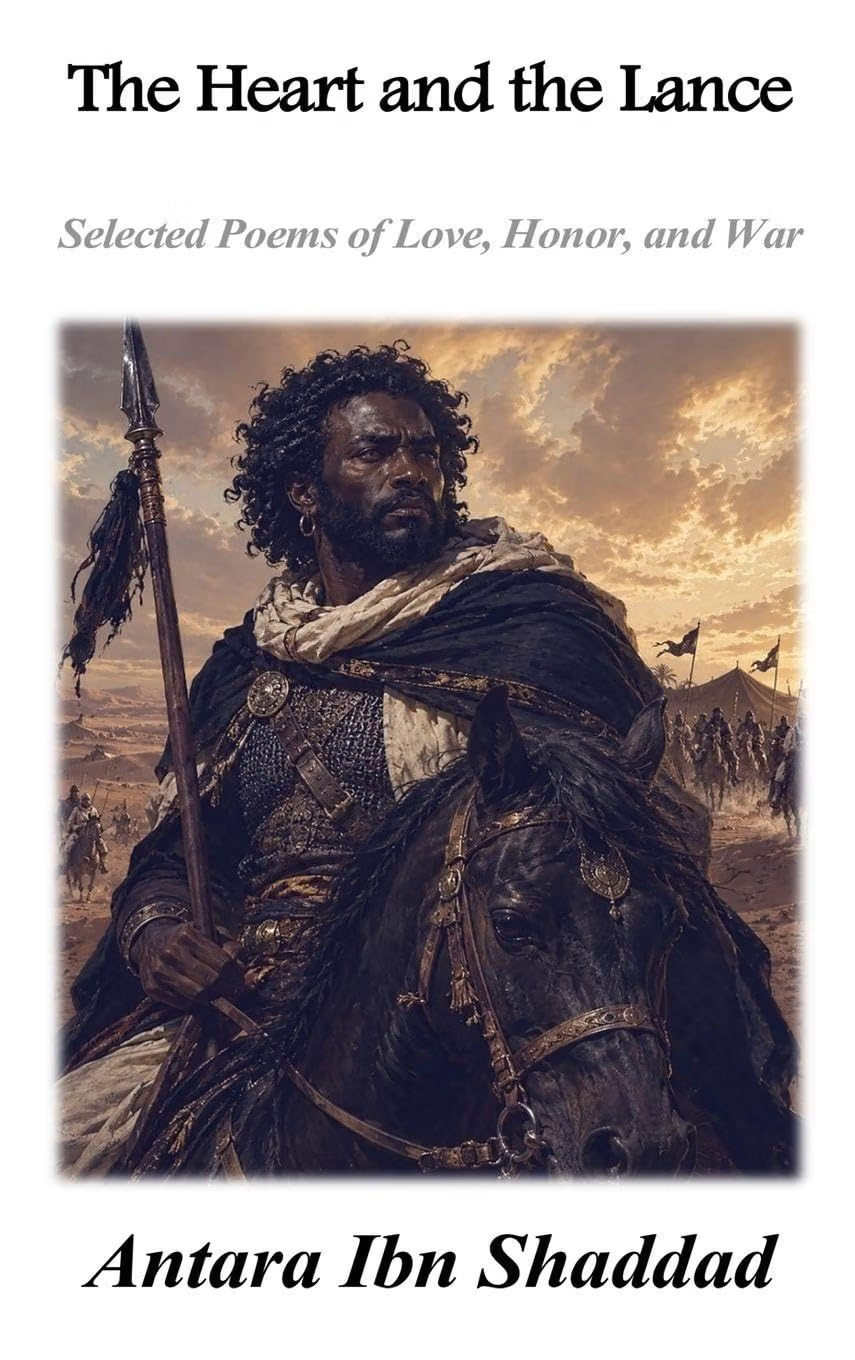
 Title: The Heart and the Lance
Author: Antara Ibn Shaddad
Publisher: Majalla Press
Publication date: July 15, 2026
Language: English and Arabic
Print length: 218 pages
ISBN: 979-8888230268
Item Weight: 1.24 pounds
Dimensions: 6 x 0.75 x 9 inches
Price: $49.29
The Heart and the Lance is a remarkable new edition that reintroduces modern readers to the legendary pre-Islamic Arab poet and warrior, Antara Ibn Shaddad (circa 525–608 CE). This 218-page hardcover volume offers a carefully selected collection of his verses, presented in the original Arabic alongside new, poetic English translations. More than a simple translation, the book serves as a comprehensive gateway into the life, world, and enduring legacy of one of the greatest figures of classical Arabic literature.
Antara ibn Shaddad al-Absi was a renowned poet and knight belonging to the Arab tribe of Banu Abs. Born to an Ethiopian enslaved mother and an Arab chief, he overcame immense social stigma to become a celebrated hero and a master of the pre-Islamic qasida (ode). His historical reputation rests on two pillars: his unmatched bravery on the battlefield and his eloquent, passionate poetry. This duality is perfectly captured in the book’s title, The Heart and the Lance, which reflects the extraordinary range of Antara’s voice—from tender, longing love poems to stirring celebrations of courage, honor, and human dignity.
The core of the book is the bilingual presentation of Antara’s poetry. For scholars and students of Arabic, having the original text alongside a fresh English translation is invaluable. The translations manage to retain the rhythmic gravity and vivid desert imagery characteristic of 6th-century Arabian poetry, while remaining accessible to contemporary English readers.
What elevates this edition above a standard poetry anthology is its supplementary material. The volume is richly supplemented with historical and literary essays that contextualize the poems. These essays provide essential background on the Jahiliyyah (pre-Islamic) period, the oral tradition of the Mu’allaqat (the “Hanging Poems,” of which Antara’s work is a famous part), and the evolution of his historical persona into the later epic Romance of Antar. This framing helps modern readers navigate the sometimes fragmented, non-linear structure of classical Arabic odes.
The primary strength of The Heart and the Lance is its ability to make a 1,500-year-old text feel urgently relevant. The book’s description rightly notes that these poems remind us that “love, courage, memory, and the search for dignity belong not to one civilization alone, but to the shared inheritance of humanity.” Antara’s struggles with identity, his fight for social recognition, and his profound devotion resonate deeply with modern themes of resilience and self-determination.
If there is a minor limitation, it is that readers entirely unfamiliar with classical Arabic poetry might initially find the traditional monorhyme and abrupt thematic shifts of the qasida form challenging. However, the editorial essays do an excellent job of mitigating this by gently guiding the reader through the conventions of the genre.
The Heart and the Lance is a masterful and timely publication. It successfully bridges cultures and centuries, offering both a beautiful literary experience and a vital historical document. Whether you are a student of world literature, a poetry enthusiast, or simply a reader drawn to the roots of chivalric tradition, this volume is a highly recommended addition to your library. Antara Ibn Shaddad’s voice has echoed for fifteen centuries, and this edition ensures it will continue to inspire for many more.
