
From the Korean Peninsula to the South Asian Flashpoint and Beyond
As of mid-2026, the global nuclear landscape is defined by a perilous paradox. While international non-proliferation frameworks strive to contain the spread of atomic weapons, the strategic behavior of established nuclear powers has inadvertently validated the security anxieties of non-nuclear states, triggering a cascading effect of regional arms races. Nowhere is this dynamic more acute than in the escalating nuclear posturing between India and Pakistan, even as Islamabad attempts to leverage its unique geopolitical position to mediate a broader conflict in Southwest Asia.
US, Israel, and the Proliferation Domino
The strategic calculus of non-nuclear states has been profoundly shaped by the actions of nuclear-armed powers. The United States and Israel, both possessing advanced and undeclared or declared nuclear arsenals, have at times leveraged this asymmetry to exert maximum diplomatic and military pressure on non-nuclear adversaries. For nations facing perceived existential threats, this dynamic serves as a stark lesson: international law and non-proliferation treaties offer little protection against regime-change threats or overwhelming conventional superiority.
For Pyongyang, this reality was the foundational catalyst for its nuclear ambitions. North Korea’s relentless pursuit of nuclear capabilities was not born in a vacuum; it was a direct, response to a perceived security vacuum. Observing the fate of non-nuclear states that abandoned their deterrent programs, North Korea concluded that only a credible nuclear arsenal could guarantee regime survival against the combined pressure of the United States and its allies. This “lesson” of nuclear asymmetry has since echoed across the globe, reinforcing the belief among certain states that nuclear weapons are the ultimate guarantor of sovereignty.
India and Pakistan’s Nuclear Escalation
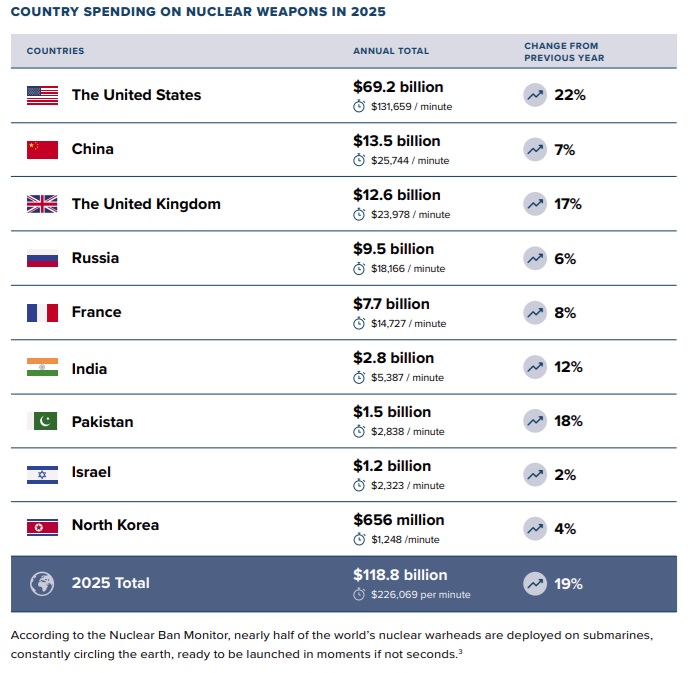
This logic of nuclear deterrence is now acutely visible in South Asia, where historical animosities are being fueled by record-breaking military expenditures. According to a 2025 report by the International Campaign to Abolish Nuclear Weapons (ICAN), global nuclear arms spending reached an unprecedented $119 billion. Within this landscape, Pakistan emerged as the second-fastest spender among the nine nuclear powers, increasing its nuclear budget by 18% to $1.5 billion. Only the United States registered a higher percentage increase in its nuclear spending (22%).
India, responding to its own strategic imperatives and the growing capabilities of its neighbor, expanded its nuclear expenditure by 12% in 2025, reaching $2.8 billion.
The friction is not merely financial; it is operational and highly volatile. In May 2025, following an attack in Kashmir, India and Pakistan engaged in reciprocal drone and missile strikes against each other’s territories. Although a ceasefire was rapidly brokered to prevent total war, underlying tensions remain on high alert, and the rhetoric has grown increasingly stark.
Pakistan’s Army Chief, Field Marshal Asim Munir, recently issued a chilling warning regarding his country’s red lines: “We are a nuclear nation. If we think we are going down, we’ll take half the world down with us.”
In response, Indian Prime Minister Narendra Modi firmly drew a line in the sand, stating, “Nuclear blackmail has been going on for a long time, but now India will not tolerate blackmail… We are ready to give a befitting reply.”
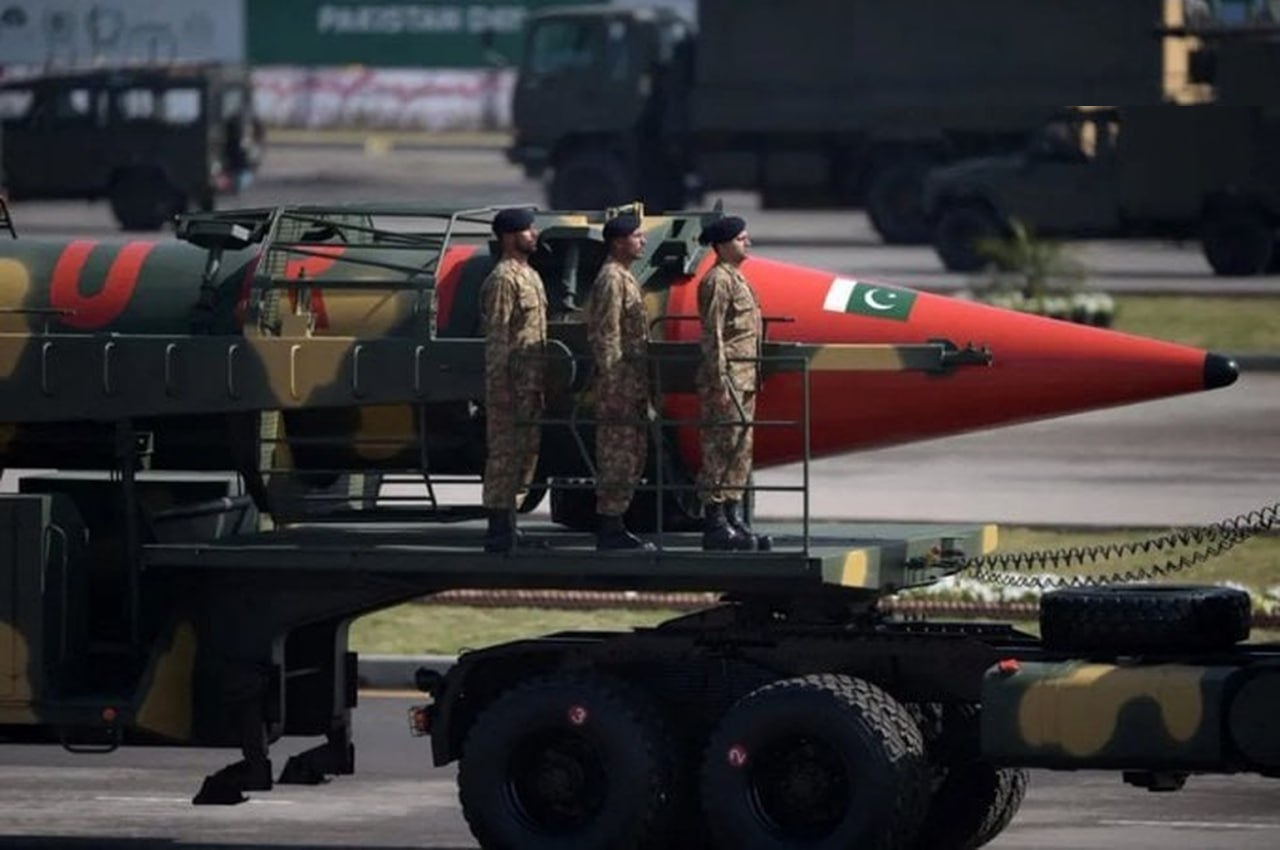
Pakistan’s deterrent posture is backed by a robust and evolving arsenal. Open-source intelligence estimates that Pakistan possesses approximately 170 nuclear warheads, structured around a developing strategic triad:
- Land-based (Primary): Shaheen ballistic missiles (range up to 2,750 km) and Ghauri missiles, supplemented by short-range tactical systems like the Nasr missile (70 km range) and Babur cruise missiles.
- Air-based: Mirage III/V fighter jets equipped with Ra’ad air-launched cruise missiles (350 km range).
- Sea-based (Under Development): The Babur-3 submarine-launched cruise missile, designed to ensure a credible second-strike capability.
Pakistan’s Evolving Geopolitical Role
In a striking geopolitical paradox, Pakistan is simultaneously stepping into a role of regional stabilizer. As the world’s only nuclear-armed Muslim-majority state, Islamabad is currently positioning itself as a crucial mediator in the escalating Southwest Asian conflict involving Israel and the United States who attacked Iran outside the UNSC authority.
This mediation effort underscores a complex duality in Pakistan’s foreign policy. On one hand, it is aggressively modernizing its nuclear arsenal to counter perceived existential threats from India, engaging in the very brinkmanship it warns against. On the other hand, it is leveraging its unique strategic weight, military credibility, and diplomatic channels to de-escalate a broader regional conflagration that threatens to engulf the entire Middle East and the South Asian periphery.
By engaging with Tehran and Washington, Pakistan is attempting to translate its nuclear-armed status from a mere instrument of bilateral deterrence into a platform for multilateral diplomatic leverage. Its ability to communicate with actors often isolated from Western diplomatic circles gives it a unique, albeit precarious, seat at the negotiation table.
An Existential Imperative for Diplomacy
The trajectory of global nuclear politics in 2026 demands a sober reassessment of international security frameworks. The actions of established nuclear powers have inadvertently validated the security anxieties of states like North Korea, while the relentless arms race in South Asia demonstrates how quickly regional disputes can escalate to the nuclear threshold.
As Pakistan navigates its dual identity as both a nuclear-armed state engaged in an arms race and a prospective peace mediator in Southwest Asia, the international community must recognize a fundamental truth: sustainable security cannot be built on the foundation of nuclear asymmetry, coercion, and brinkmanship. Addressing the root causes of these security dilemmas—through verifiable arms control, conflict resolution in contested regions like Kashmir and Palestine, and inclusive diplomatic frameworks—is an existential imperative for global stability.


