Asymmetric Endurance
Abstract
In the contemporary landscape of geopolitical conflict, the disparity between conventional military power and asymmetric resistance has necessitated the evolution of strategic doctrines that prioritize endurance over immediate victory. This article examines the Iranian strategic framework known as “Mosaic Defense,” analyzing its structural and theoretical alignment with the classical principles of protracted war articulated by Mao Zedong. By synthesizing the historical tenets of “On Protracted War” with modern Iranian military adaptations, this analysis elucidates how a state actor can neutralize technological superiority through decentralization, leadership redundancy, and the weaponization of time. The study highlights the shift from territorial defense to societal resilience, demonstrating how the integration of regular and irregular forces creates a system capable of withstanding decapitation strikes and sustaining long-term attrition.
Introduction
The history of modern warfare is often framed by the dichotomy between the blitzkrieg, or lightning war, and the war of attrition. While dominant military powers frequently seek rapid resolution through overwhelming force and technological precision, weaker state and non-state actors have historically turned to strategies that extend the duration of conflict to erode the enemy’s political will and logistical capacity. In the Middle East, the Islamic Republic of Iran has developed a distinct strategic culture that rejects the premise of rapid defeat in favor of long-term endurance. This approach, formally encapsulated in the concept of “Mosaic Defense,” represents a sophisticated institutionalization of protracted war theory.
The doctrinal foundations of this strategy are not merely reactive but are deeply rooted in historical precedents of asymmetric conflict, most notably the theoretical framework established by Mao Zedong during the Second Sino-Japanese War. By examining the structural components of Iran’s defense strategy—including decentralized command, pre-designated leadership succession, and the economic logic of asymmetric weaponry—it becomes evident that the Iranian model is a direct descendant of Maoist thought, adapted for the complexities of the twenty-first century. This article explores the mechanics of this doctrine, arguing that its primary objective is not the immediate defense of geography, but the preservation of decision-making continuity and the imposition of unsustainable costs upon a technologically superior adversary.
The Theoretical Foundation: Time as a Strategic Asset
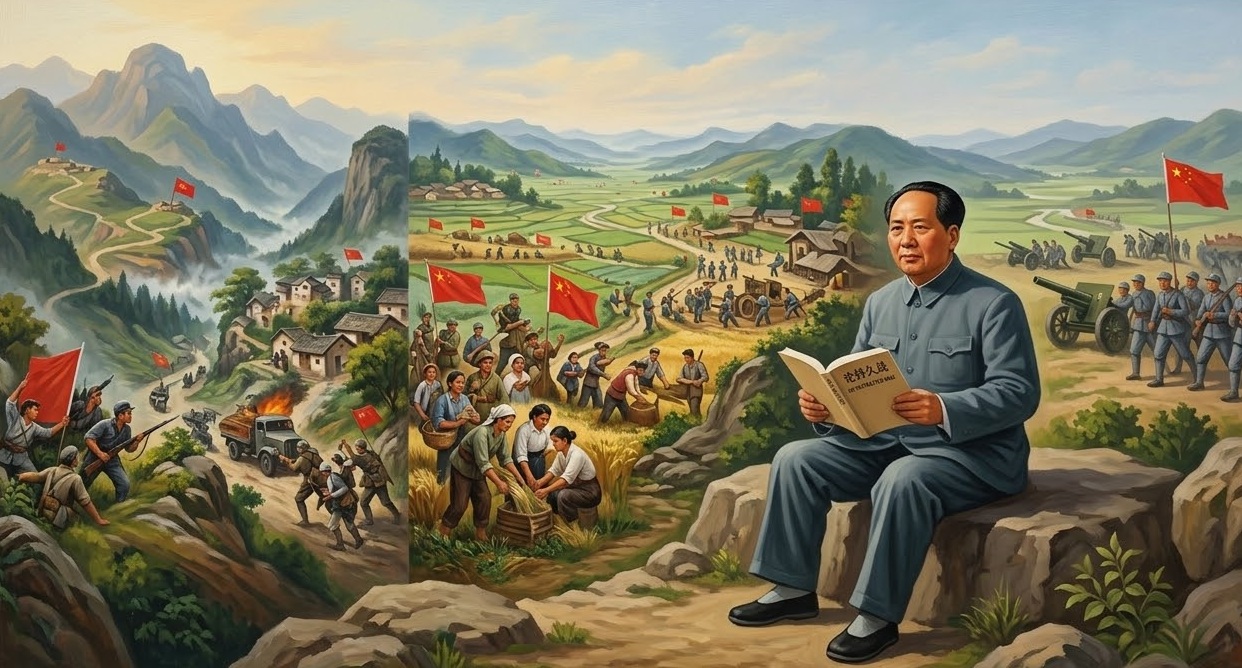
The intellectual lineage of the Iranian defense doctrine can be traced to the seminal work “On Protracted War,” published in 1938. In this text, Mao Zedong challenged the prevailing notions of military engagement between unequal powers. He argued that for a weaker nation facing a stronger invader, the pursuit of a quick victory is a strategic illusion, just as the acceptance of inevitable defeat is a psychological failure. Instead, Mao posited that time itself could be weaponized. By trading space for time, a weaker force could transform the enemy’s material superiority into a logistical and political burden.
Mao delineated this process into three strategic stages: the stage of strategic defense, the stage of strategic stalemate, and the stage of strategic counter-offense. In the initial phase, the weaker party avoids decisive engagements, focusing instead on guerrilla tactics and the preservation of forces. The second phase, often the longest and most difficult, involves a stalemate where the enemy’s advance is halted, and their resources are gradually depleted through harassment and the extension of supply lines. Finally, as the balance of power shifts due to the erosion of the enemy’s will and the mobilization of the populace, the resistance transitions to a strategic offensive.
Iranian strategists have internalized this tripartite structure, adapting it to a modern context where the “population” is not merely a source of recruits but an integrated component of the defense infrastructure. The Iranian interpretation acknowledges that a conventional military confrontation with powers such as the United States or Israel would result in rapid defeat due to disparities in air power and precision munitions. Consequently, the doctrine prioritizes the second phase of Mao’s theory—strategic stalemate—as the central arena of conflict. The goal is to deny the adversary a decisive victory, thereby dragging the conflict into a timeline where political and economic costs outweigh potential gains.
Mosaic Defense: Institutionalizing Decentralization
The operational manifestation of this protracted war theory is the “Mosaic Defense.” This concept moves beyond traditional military hierarchy to create a decentralized network of command and control. The core tenet of Mosaic Defense is that the destruction of the capital city or the elimination of the supreme leadership should not result in the collapse of the state’s war-fighting capability. This stands in stark contrast to centralized command structures where the decapitation of leadership often leads to systemic paralysis.
To achieve this, the Iranian military structure distributes authority across thirty-one regional command centers, corresponding to the country’s provinces. This geographic distribution ensures that if communication with the central command in Tehran is severed, regional commanders possess the autonomy to continue operations based on pre-established strategic guidelines. This decentralization extends to the integration of various military branches. The regular army, known as the Artesh, is tasked with conventional border defense and absorbing the initial shock of an invasion. However, the burden of long-term resistance shifts to the Islamic Revolutionary Guard Corps (IRGC) and the Basij militia.
The Basij, originally conceived as a popular mobilization force, has been restructured to function as a localized insurgency capability within Iran’s own borders. By embedding these forces within the civilian population and urban centers, the doctrine ensures that any occupying force would face resistance not just from uniformed soldiers, but from a fragmented, ubiquitous network capable of guerrilla warfare, ambushes, and the disruption of supply lines. This mirrors Mao’s emphasis on the “sea” of the people in which the guerrilla “fish” swim. The Iranian model formalizes this relationship, placing the Basij under the operational command of the IRGC to ensure ideological cohesion and tactical coordination without relying on a single point of failure.
Leadership Continuity and the Fourth Alternative
A critical vulnerability in any protracted war strategy is the stability of political and military leadership. Recognizing that modern warfare often targets command nodes to induce chaos, the Iranian doctrine incorporates a rigorous system of succession planning. This system, often referred to as the “Fourth Alternative,” mandates that for every high-ranking military or government position, there are up to four pre-designated successors.
This protocol is applied both vertically and horizontally throughout the state apparatus. In the event that a leader is killed, incapacitated, or cut off from communication, the next in line immediately assumes authority without the need for a deliberative selection process. This mechanism is designed to prevent a power vacuum and ensure the continuity of the state even under the worst-case scenarios, including the loss of the Supreme Leader. By institutionalizing redundancy, the system negates the strategic value of assassination or decapitation strikes. The message conveyed to adversaries is that the removal of individuals does not equate to the removal of the system. This resilience transforms the leadership structure into a hydra-like entity, where the loss of one head results in the immediate activation of another, maintaining the momentum of the war effort.
The Economics of Attrition: Asymmetric Cost Exchange
The viability of a protracted war depends heavily on the economic sustainability of the resistance compared to the aggressor. Iranian strategy leverages the concept of the cost-exchange ratio to exhaust the adversary financially. A prime example of this is the deployment of unmanned aerial vehicles (UAVs), such as the Shahed drone series. These systems are produced at a fraction of the cost of the advanced interceptor missiles required to destroy them.
When an adversary spends millions of dollars to intercept a threat that costs only tens of thousands of dollars to produce, the economic logic of the war shifts. Over time, the defender can sustain production and deployment longer than the attacker can sustain defense. This asymmetry forces the technologically superior power to deplete expensive stockpiles against low-cost threats, creating a fiscal drain that complements the physical attrition. Furthermore, the Iranian doctrine extends this economic warfare to the maritime domain. By threatening critical choke points such as the Strait of Hormuz with swarms of fast-attack craft and naval mines, Iran can impose global economic costs that ripple far beyond the immediate theater of war. This capability serves as a deterrent and a tool of leverage, ensuring that the conflict remains costly for the international community, thereby increasing diplomatic pressure on the aggressor to seek a resolution.
Regional Proxies and Strategic Depth
While Mao’s theory focused primarily on internal mobilization, the Iranian adaptation expands the battlefield regionally. The utilization of allied militias and proxy groups across the Middle East serves to extend the front lines beyond Iran’s borders. This network creates a multi-axis threat environment, forcing adversaries to divide their attention and resources across several theaters simultaneously.
In the context of protracted war, this regional network functions as an external layer of the Mosaic Defense. If the conflict remains contained within Iran, the war is fought on Iranian terms of attrition. However, by activating regional proxies, the conflict can be escalated to impose additional costs on the adversary’s allies and interests abroad. This capability complicates the adversary’s strategic calculus, as a localized strike against Iran risks triggering a broader regional conflagration. The proxies act as force multipliers, allowing Iran to project power and sustain pressure without committing its regular forces, thereby preserving its core strength for the defense of the homeland. This approach aligns with the Maoist principle of expanding the scope of the conflict to dilute the enemy’s concentration of force.
From Rural Base to Urban Resilience
A significant evolution in the application of protracted war theory is the shift from rural to urban centers. Mao’s original model relied heavily on the countryside as a base area to surround the cities. However, with more than half of the global population now residing in urban environments, the Iranian doctrine adapts this concept to the modern demographic reality. The Mosaic Defense envisions the city itself as a battleground where irregular forces can operate within the urban fabric.
This urbanization of resistance complicates the use of heavy conventional firepower by an invading force, as the risk of collateral damage and civilian casualties becomes a significant political liability. By integrating defense into the urban landscape, the doctrine ensures that every neighborhood possesses the potential to become a node of resistance. This transforms the societal structure into a defensive grid, where the distinction between civilian and combatant blurs in the context of total war. The resilience of the society becomes the ultimate defense, relying on ideological indoctrination and organizational depth to maintain morale during extended periods of hardship and bombardment.
Conclusion
The doctrine of Protracted War, as articulated in the mid-twentieth century, remains a potent framework for understanding modern asymmetric conflict. Iran’s Mosaic Defense represents a contemporary institutionalization of these principles, tailored to address the specific threats posed by modern air power and precision warfare. By decentralizing command, ensuring leadership redundancy, leveraging economic asymmetries, and integrating society into the defense apparatus, the strategy seeks to neutralize the advantages of a technologically superior foe.
The core insight of this doctrine is that military victory is not defined solely by the control of territory, but by the survival of the political will to fight. In a conflict scenario where the adversary seeks a rapid, decisive conclusion, the ability to prolong the war and increase its cost becomes a strategic victory in itself. As demonstrated by the structural preparations for leadership continuity and the integration of irregular forces, the Iranian model is designed to withstand the initial shock of a decapitation strike and transition into a long war of attrition. Ultimately, the convergence of Maoist theory and modern Iranian strategy underscores a enduring truth of warfare: when a weaker actor can successfully weaponize time and resilience, the definition of victory for the stronger power becomes increasingly elusive.